
Field Notes · November 13, 2026 · Tiki Culture & History
Tiki Mug Collecting: A Beginner's Guide to Vintage and Modern Mugs
Learn how to collect tiki mugs, identify vintage pieces, discover famous makers, avoid costly mistakes, and display your collection.
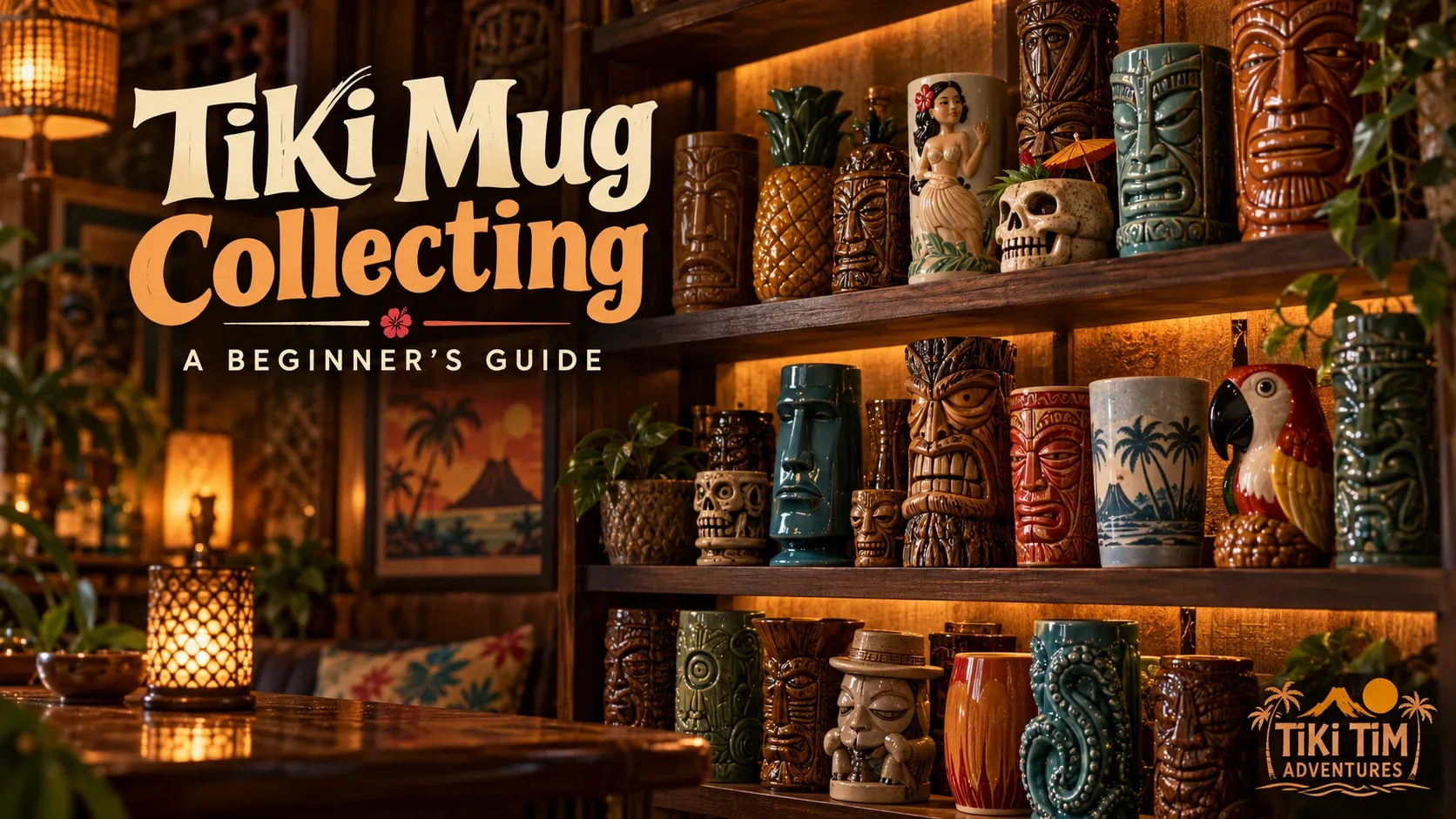
There's something wonderfully ridiculous about owning a drinking vessel shaped like a grinning ceramic head.
And then buying another one.
And another.
Before long, the shelf that once held a few cocktail glasses looks like a miniature museum of mysterious faces, tropical creatures, forgotten restaurants, and colorful works of art.
Welcome to tiki mug collecting.
What begins as a souvenir from a favorite tiki bar can become a fascination with midcentury design, ceramic craftsmanship, restaurant history, and the artists keeping American tiki culture alive.
Some collectors search for original mugs from legendary establishments that closed decades ago. Others chase limited-edition releases from contemporary ceramic artists. Some simply bring home a mug whenever they visit a new tiki bar.
There isn't one correct way to collect.
But there's quite a bit to know before you start filling those shelves.
This guide explores where tiki mugs came from, what makes them collectible, how to identify vintage examples, and how to build a collection that means something beyond the price tag.
Because the best tiki mug isn't necessarily the rarest.
Sometimes, it's the one that reminds you of an unforgettable night.
What Makes Tiki Mugs So Collectible?
At first glance, a tiki mug is simply an elaborate container for a tropical cocktail.
Look a little closer, and things get interesting.
Unlike ordinary drinkware, tiki mugs often combine sculpture, graphic design, restaurant branding, and storytelling in a single object.
A mug might feature a playful face, a mythical creature, an elaborate tropical scene, or a character invented for a particular bar.
Some are whimsical. Others are beautifully detailed. A few are so strange that you have to wonder what the artist was thinking.
That's part of their appeal.
But collectors generally become interested for several overlapping reasons.
A Piece of Tiki History

During the American tiki boom of the mid-20th century, themed restaurants transported customers into elaborate fantasy environments inspired by the South Pacific.
Restaurants weren't simply selling drinks and dinner.
They were selling an experience.
The lighting, music, architecture, menus, décor, and cocktail presentations all contributed to that atmosphere.
Specially designed ceramic vessels became part of the theater.
Today, a surviving restaurant mug can provide a tangible connection to a place that no longer exists.
A faded restaurant name stamped into a ceramic base might be the only clue that a particular establishment once served tropical cocktails beneath a thatched roof.
For collectors, that's fascinating.
Original Ceramic Art
Tiki mugs are also miniature sculptures.
Artists must consider how a design looks from multiple angles, how it feels in the hand, how much liquid it holds, and whether the finished piece can actually function as drinkware.
A good mug balances imagination with practical construction.
Some feature elaborate sculptural details, while others achieve their personality with only a few carefully chosen shapes.
Contemporary artists continue experimenting with the form, creating everything from minimalist designs to remarkably elaborate ceramic pieces.
Memories and Experiences
Perhaps the most personal reason to collect tiki mugs is that they become souvenirs of experiences.
A mug purchased during a memorable vacation means something different from one ordered online.
A bar-exclusive release might bring back the music, the conversation, the drinks, and the atmosphere of a particular evening.
And a collection assembled over years becomes a visual record of places visited and experiences shared.
That's something a resale price cannot measure.
A Brief History of the Tiki Mug
To understand why people collect tiki mugs, we need to travel back to the rise of American tiki culture.
The American tiki movement developed through restaurants, bars, hospitality design, and popular entertainment during the 20th century.
Don the Beachcomber and Trader Vic helped establish the tropical restaurant experience that eventually became synonymous with tiki.
But the iconic sculptural tiki mug did not appear fully formed at the beginning of that movement.
Before the Familiar Tiki Mug
Early tropical restaurants served drinks in a variety of distinctive vessels.
Ceramic bowls, decorative cups, and specialty cocktail containers helped make elaborate drinks feel like part of a larger experience.
Trader Vic's, in particular, became associated with distinctive drink presentations.
These early vessels helped establish an important idea: the container could be part of the cocktail's identity.
A drink served in a memorable ceramic object was more than a beverage.
It was a souvenir-worthy performance.
However, the exact origins of the sculptural tiki mug remain debated.
Different historians and collectors distinguish between early themed cocktail vessels and the later mugs shaped like recognizable tiki figures.
That distinction matters.
There is no universally accepted, fully documented account establishing a single inventor of every form now grouped under the term tiki mug.
Tiki Bob and the Rise of an Icon
One of the most influential early designs appeared at Tiki Bob's in San Francisco.
The restaurant opened in 1955 under Bob Bryant, who had previously worked at Trader Vic's.
Its mascot, designed by Alec Yuill-Thornton, featured a remarkably simple face with a cheerful expression.
The associated ceramic mug became an enduring collectible.
The original Tiki Bob design is generally credited to Yuill-Thornton and associated with production by Otagiri.
Its face is instantly recognizable to many tiki collectors.
There is something almost comical about how little decoration it requires to become memorable.
A simple expression, a distinctive shape, and an association with a legendary restaurant were enough.
Today, original Tiki Bob mugs and their many variations remain subjects of considerable collector interest.
The design has also inspired later interpretations and reproductions.
That creates an important lesson for beginners: recognizing a famous design is not the same as identifying an original example.
A mug that resembles Tiki Bob is not automatically a mug from the original San Francisco restaurant.
The Restaurant Mug Boom

As tropical restaurants expanded during the 1950s and 1960s, specialty ceramic drinkware became increasingly common.
Restaurants could commission distinctive vessels carrying their names, logos, or original designs.
These objects helped reinforce the identity of the establishment.
They also gave customers something tangible to remember.
Otagiri Mercantile Company was among the firms associated with producing themed ceramic drinkware during this period.
The Smithsonian's National Museum of American History preserves a green ceramic Mai Tai cup commissioned by restaurateur Cecilia Chiang for The Mandarin Restaurant.
That object demonstrates how tropical drink presentation extended beyond the most famous tiki establishments and became part of a broader restaurant culture.
Importantly, it also preserves the history of Chiang, a pioneering Chinese American restaurateur whose contribution deserves recognition.
Tiki drinkware history isn't limited to the men whose names appeared above the doors of famous tropical bars.
It also includes designers, ceramic manufacturers, hospitality entrepreneurs, and the workers who brought these objects into production.
From Forgotten Souvenirs to Collectibles
American tiki's popularity eventually declined.
As restaurant tastes changed, many elaborate tropical establishments closed, remodeled, or discarded their original décor.
Ceramic mugs survived in cupboards, thrift stores, estate sales, and private collections.
Over time, collectors began recognizing these objects as artifacts of a distinctive design movement.
The broader tiki revival renewed interest in original restaurant mugs, historic interiors, vintage menus, and related decorative objects.
Older mugs acquired new significance.
They were no longer simply unusual drinkware.
They had become surviving pieces of American Polynesian Pop history.
The Modern Tiki Mug Revival
Contemporary tiki mug collecting is not exclusively about vintage objects.
In 2000, Holden Westland founded Tiki Farm, a company that became a major producer of contemporary ceramic tiki drinkware.
Tiki Farm has worked with artists, bars, restaurants, and other clients to develop original designs and commissioned pieces.
Its collaborations have helped introduce new generations of collectors to contemporary tiki ceramics.
Independent ceramic artists also contribute significantly to the modern collecting scene.
Today, an original modern mug can be desirable because of its artist, design, craftsmanship, association with a particular establishment, or limited production.
A mug doesn't have to be 70 years old to be interesting.
And being old doesn't automatically make a mug valuable.
The Five Main Types of Collectible Tiki Mugs
Once you begin browsing collections, you'll discover that tiki mugs come in several overlapping categories.
Understanding these categories makes it easier to decide what kind of collection you actually want.
1. Vintage Restaurant Mugs
These are mugs originally produced for restaurants, bars, and hospitality establishments during earlier periods of American tiki culture.
Some carry a restaurant name or logo.
Others are associated with particular venues through documented designs, manufacturers, or surviving examples.
For collectors interested in history, original restaurant mugs can be especially compelling.
They connect the object to a specific time and place.
But the word vintage should never be accepted without evidence.
An old-looking glaze or a familiar design does not establish the date of manufacture.
2. Contemporary Artist-Designed Mugs

Modern artist mugs emphasize original design and craftsmanship.
They may feature traditional sculptural techniques, experimental glazes, elaborate characters, or entirely new interpretations of tropical fantasy.
Some are produced in small numbers.
Others are regular production designs.
Collecting contemporary mugs is also a way of supporting working artists.
And unlike vintage collecting, it gives enthusiasts the opportunity to follow creators as they release new work.
3. Tiki Bar Exclusives

Some tiki bars commission original mugs that are available primarily through their own establishments.
These can become particularly meaningful souvenirs.
A mug from a favorite bar represents both the artist's work and the experience of visiting that location.
Availability varies.
Some designs remain in production for years, while others are produced for a limited period.
Before traveling specifically to purchase a mug, check directly with the establishment about availability.
A mug featured online may have sold out long ago.
4. Event and Limited-Edition Mugs

Tiki festivals, collector gatherings, anniversaries, and special events sometimes feature commemorative releases.
These mugs may be tied to a particular year, celebration, artist, or venue.
Limited editions can create excitement among collectors, but an edition number is only one piece of information.
A release described as limited is not automatically valuable.
Its desirability depends on many factors, including design, demand, and the number of collectors interested in owning one.
5. Reproductions and Homage Mugs

Reproductions revisit older designs.
Some are authorized reissues, while others are independently produced interpretations or homages.
These are not necessarily bad collectibles.
An affordable reproduction may be exactly what a beginner wants.
The important distinction is honesty about what the object actually is.
A clearly identified modern reproduction can be an enjoyable addition to a collection.
A reproduction misleadingly represented as a scarce original is a different matter.
How to Identify Vintage Tiki Mugs

Finding an unfamiliar tiki mug at an antique shop can be exciting.
But identifying it correctly requires more than enthusiasm.
The best approach is to investigate the evidence systematically.
Check the Bottom of the Mug

Start with the base.
Look for manufacturer names, country-of-origin markings, embossed lettering, printed stamps, artist signatures, or surviving paper labels.
These details may help narrow down the object's origin.
But be careful.
Not every original mug is marked.
Not every marked mug is old.
And a manufacturer's name may have been used across multiple designs and production periods.
A mark is a clue, not a complete biography.
Look for Restaurant Names or Logos
Restaurant branding can be particularly useful.
A venue name, location, or identifying logo may connect the mug to a documented establishment.
However, some popular designs were used by multiple venues or reproduced in later years.
The original Tiki Bob mug, for example, has recognizable visual characteristics, while other versions and related designs require closer comparison.
The exact lettering, glaze, shape, dimensions, and manufacturing details may matter.
Examine the Glaze and Construction
Look carefully at the ceramic surface.
Note the color, finish, sculptural detail, and overall construction.
A glaze may be glossy, matte, textured, or deliberately uneven.
Small variations can occur within production runs.
However, age cannot be reliably determined by glaze appearance alone.
Manufacturers can reproduce older-looking finishes, and older pieces can remain remarkably well preserved.
Measure the Mug
Dimensions are often overlooked.
Record the height and approximate width.
If practical, document its liquid capacity without risking damage.
Two mugs with nearly identical faces may have different sizes or proportions.
Measurements can help distinguish variants when compared with reliable collector references.
Use Collector Databases
One of the most useful resources for identification is MyTiki.life.
The database includes listings for collectible mugs, artists, manufacturers, venues, and design variations.
Another useful resource is The Search for Tiki, which documents collectible mugs and provides identifying information for many releases.
These resources are excellent starting points.
But collector databases can contain incomplete information, disputed dates, or entries that need further verification.
Compare multiple examples whenever possible.
Document What You Find
When you identify a mug, record the information.
A simple collection record might include:
- Mug name and manufacturer
- Artist or designer, if known
- Restaurant or venue association
- Approximate production period
- Dimensions and identifying marks
- Purchase location and date
- Price paid
- Condition
- Supporting reference links
Photograph the mug from the front, back, sides, and bottom.
This information becomes useful when your collection grows, when you need to distinguish similar releases, or when you decide to sell or insure a piece.
What Makes a Tiki Mug Rare or Valuable?
This is where collecting can become expensive.
It can also become confusing.
A seller might describe a mug as rare, limited, vintage, impossible to find, or highly collectible.
Those descriptions sound impressive.
But they don't establish market value.
Several factors are worth considering.
Scarcity
An object produced in small quantities may be harder to find than a mass-produced example.
But scarcity alone isn't enough.
A mug can be extremely uncommon and still have little demand.
Likewise, a widely recognized design may remain desirable even when numerous examples exist.
Historical Significance
A documented connection to an influential restaurant, designer, or moment in tiki history may increase collector interest.
A mug associated with a well-known establishment can carry historical appeal beyond its ceramic design.
The quality of the documentation matters.
Artist and Design
Collectors sometimes follow particular artists or design styles.
An original work by an established creator may attract attention because of the artist's reputation and body of work.
But the market for individual creators changes.
A popular name does not guarantee that every piece will appreciate.
Condition
Cracks, chips, repairs, staining, and glaze damage can affect both appearance and desirability.
A professionally restored vintage mug might still appeal to a collector, but repairs should be disclosed.
Condition is especially important when comparing prices for similar objects.
Two examples of the same design may sell for significantly different amounts depending on their state of preservation.
Documented Sales
If you're evaluating a price, look for completed sales of comparable examples.
Asking prices tell you what a seller hopes to receive.
Completed sales provide better evidence of what buyers have actually paid.
Even then, compare condition, edition, provenance, and timing.
A single unusually high sale doesn't establish a permanent value for every mug of the same design.
The best rule for beginners: buy something you would still enjoy owning if its resale value never increased.
That's a much healthier foundation for a collection than treating every new release like a retirement account.
Tiki Mug Artists and Makers Worth Knowing
Tiki mug history is a story of designers, manufacturers, sculptors, and entrepreneurs.
No single person deserves credit for every stage of its development.
A few names provide useful starting points.
Alec Yuill-Thornton
Yuill-Thornton designed the Tiki Bob mascot, one of the most recognizable images associated with vintage tiki ceramics.
The design's clean lines and friendly expression help explain why it has been repeatedly referenced by later artists and collectors.
Otagiri Mercantile Company
Otagiri was associated with Japanese-manufactured ceramic drinkware supplied to American establishments.
Its involvement in restaurant mugs illustrates the international manufacturing and commercial networks behind American Polynesian Pop.
Otagiri markings and associations can be useful identification clues, although collectors must evaluate individual pieces rather than assume every example has the same origin or value.
Holden Westland and Tiki Farm
Founded in 2000 by Holden Westland, Tiki Farm helped expand the contemporary market for artist-designed tiki ceramics.
Its partnerships and commissioned work have connected mug collecting with a wide variety of modern bars, designers, and enthusiasts.
Tiki Farm is particularly useful for beginners because it demonstrates how a modern collectible mug can be both functional drinkware and original artistic work.
Scott Taylor and TikiPop Maui
One contemporary tiki mug artist whose work has found its way into my personal collection is Scott Taylor, the creator behind TikiPop and Beachbumz on Maui.
Scott specializes in handmade ceramic tiki mugs, combining sculptural designs, detailed textures, and distinctive glazing. His work reflects the creativity and craftsmanship that make contemporary tiki mug collecting so interesting.
The brown, woodgrain-style mug pictured here is from my own collection. Its sculpted face is striking, but turning it over reveals another part of the story: the TikiPop Maui maker's mark and handwritten details.

I've also had the opportunity to meet Scott and have a photograph with him. That's one of the things I appreciate about collecting. Behind the ceramic pieces are actual artists and people whose work deserves recognition.
You can explore Scott's creations at Beachbumz Tiki & Gift Shop.

Independent Artists
Beyond major manufacturers, the collecting community includes independent ceramic artists who design, sculpt, glaze, and distribute their own work.
These artists deserve direct credit for their creations.
Whenever possible, identify the individual designer and sculptor rather than attributing every creative decision to the company or venue that sold the mug.
Following artists can also help collectors discover new work without relying exclusively on resale marketplaces.
Where to Buy Tiki Mugs

There are several ways to begin a collection, and each offers a different experience.
Tiki Bars
Buying a mug directly from a tiki bar is one of the most enjoyable approaches.
You get a souvenir connected to an actual experience.
Some bars offer mugs individually, while others feature special drink-and-mug packages.
Availability changes, so it's worth checking before visiting.
If you're building a personal tiki trail, collecting a mug from each favorite establishment can become part of the adventure.
Artist and Manufacturer Shops
Buying directly from artists or established manufacturers supports the people creating contemporary designs.
It's also a good way to learn about a mug's intended production details, material, edition, and care instructions.
You may find regular releases, collaborations, and limited runs.
Tiki Events and Conventions
Tiki festivals and collector events can introduce you to artists, vendors, and fellow enthusiasts.
They can also provide opportunities to examine mugs in person before purchasing.
For beginners, the conversations can be just as valuable as the merchandise.
Ask people what they collect and why.
You'll quickly discover there are many different approaches.
Antique Shops and Estate Sales
Vintage hunting offers the possibility of finding something unexpected.
But it requires patience and careful inspection.
Not every tropical-themed ceramic item is a collectible tiki mug, and not every unfamiliar mug is rare.
Research first, then decide what you're comfortable paying.
Online Resale Marketplaces
Online marketplaces can offer a wide selection of older releases, discontinued mugs, and contemporary pieces.
They also require caution.
Review seller photographs, compare identifiers, examine condition, and ask questions before purchasing.
Avoid relying on vague descriptions such as super rare without supporting evidence.
For expensive pieces, provenance and detailed photographs become especially important.
How to Display and Care for Your Tiki Mug Collection
Eventually, collecting presents an unavoidable problem.
Where do you put all these things?
Tiki mugs have an extraordinary ability to multiply while your available shelf space remains stubbornly unchanged.
A little planning can prevent an enjoyable collection from becoming a ceramic obstacle course.
Choose Stable Shelving
Ceramic mugs are often heavier than they appear.
Use shelves designed to support the combined weight of the collection.
Make sure the shelving is securely installed and resistant to tipping.
Avoid placing delicate or expensive pieces where they can easily be knocked over.
In homes with children or pets, enclosed or appropriately secured displays may be a better choice.
Give Important Pieces Some Space
Crowded shelves make it harder to appreciate individual designs.
They also increase the chance of accidental damage.
Leave enough room to lift a mug without bumping its neighbors.
For particularly valuable or fragile pieces, consider display arrangements that reduce handling.
Protect Against Sunlight and Heat
Avoid prolonged direct sunlight and extreme temperature changes.
While fired ceramic itself can be durable, decorations, decals, repairs, and certain finishes may be more vulnerable.
Keep collectibles away from locations where they could be damaged by heat, vibration, or repeated handling.
Clean With Care
For ordinary dust, a soft, dry cloth or gentle brush may be sufficient.
For modern mugs intended for beverage use, follow the manufacturer's care instructions.
Handwashing is generally the more cautious choice for decorated collectible ceramics unless the maker specifically confirms dishwasher compatibility.
Older or fragile pieces may require even gentler treatment.
Don't aggressively scrub a vintage decal or soak a mug with uncertain repairs.
When in doubt, preserve the object rather than trying to make it look brand new.
Know Whether a Mug Is Safe to Drink From
This is one of the most important distinctions in collecting.
A collectible mug is not automatically safe for beverage use.
Older ceramics, decorative pieces, damaged glazes, and products of uncertain manufacture may present food-safety concerns.
The U.S. Food and Drug Administration warns that some ceramic glazes can release lead into food and beverages.
The FDA also identifies antique, damaged, and certain handmade ceramics as categories deserving particular caution.
If a mug's food safety cannot be established, treat it as a display piece rather than drinkware.
Never use an item marked as unsuitable for food.
And remember that washing or boiling pottery does not remove lead from its glaze.
A valuable vintage mug can be admired without ever holding another cocktail.
There are plenty of modern food-safe mugs available for that job.
Catalog Your Collection
As your shelves fill, keep a simple inventory.
A spreadsheet is perfectly adequate.
Include photographs, identifying information, purchase details, and notes about condition.
If your collection becomes substantial, documentation can also help with insurance questions, estate planning, and future sales.
Most importantly, it helps you remember the stories behind the objects.
Five Mistakes Beginning Tiki Mug Collectors Should Avoid
Almost everyone makes a few mistakes when they start collecting.
Here are five worth avoiding.
Mistake 1: Assuming Old Means Valuable
Age and value are not the same thing.
A vintage mug may have historical significance but limited demand.
A newer artist-designed mug might attract considerable interest.
Research the specific object, not just its apparent age.
Mistake 2: Confusing Reproductions With Originals
Famous designs have been reissued, imitated, and interpreted for decades.
Before paying a premium for an alleged original, compare markings, dimensions, glaze, and documented examples.
When the evidence is uncertain, the price should reflect that uncertainty.
Mistake 3: Chasing Every Limited Release
Limited editions can create a powerful sense of urgency.
But buying every release can quickly become expensive.
It's perfectly reasonable to pass on a mug that doesn't fit your interests, even when everyone else seems excited about it.
You don't need every mug.
You need the mugs you actually want.
Mistake 4: Ignoring Condition
A small crack or repair may be easy to overlook in an online listing.
Ask for detailed photographs and clarification about damage.
A mug can still be worth owning with imperfections, but you should know what you're purchasing.
Mistake 5: Collecting Only for Resale
Collectible markets change.
Artists rise and fall in popularity. Trends shift. Buyers move on.
If your primary motivation is financial appreciation, every purchase becomes a speculative decision.
If you collect because you appreciate the art, history, and experiences, the collection can remain rewarding regardless of market fluctuations.
A Note About Tiki Art and Pacific Island Cultures
There's an important cultural distinction worth understanding.
American tiki, often called Polynesian Pop, developed as an American interpretation of imagined tropical environments.
It drew inspiration from multiple Pacific Island cultures, sometimes blending unrelated designs, symbols, stories, and traditions into commercial entertainment.
The result was a distinctive American design movement.
But it should not be confused with authentic Hawaiian, Māori, or other Pacific Island cultural traditions.
A mug manufactured for an American tiki restaurant is not necessarily a faithful representation of the culture its design references.
And a contemporary artist's fantasy-inspired ceramic sculpture should not automatically be described as a traditional Pacific Island object.
Collectors can appreciate Polynesian Pop while recognizing its complicated history and respecting the living cultures from which some imagery was borrowed.
For those interested in collecting beyond tiki mugs, Hawaiian-made art and authentic cultural works deserve attention on their own terms, with proper attribution and an understanding of their origins.
Being an informed collector means caring about the stories behind objects, including the stories that haven't always received enough recognition.
Build a Collection That Tells Your Story
One of the best things about tiki mug collecting is that there isn't a universal finish line.
You don't need the rarest vintage mug.
You don't need a wall of limited editions.
And you certainly don't need to compete with someone whose shelves look like an archaeological expedition through every tiki bar that ever existed.
You can begin with a single mug.
Maybe it's one you found at a local tiki bar.
Maybe it's a contemporary design from an artist whose work you admire.
Maybe it's an inexpensive vintage piece that sent you down a fascinating research rabbit hole.
From there, let your collection develop naturally.
Learn about the restaurants. Discover the artists. Ask questions. Visit places. Research the pieces you find.
And every once in a while, take a moment to appreciate what those shelves represent.
Because a really good collection isn't just an assortment of objects.
It's a record of curiosity.
It's a collection of stories, places, people, craftsmanship, and memories.
And if those stories happen to be told through a gathering of gloriously strange ceramic drinking vessels?
Well, that sounds like a pretty good adventure.
Adventure looks better in a Hawaiian shirt.
Explore more of the history, artistry, and colorful characters behind American tiki culture in the Tiki Tim Adventures Tiki & Hawaiiana collection. And if you're building your own tiki mug collection, start with the designs and experiences that mean something to you.
Frequently Asked Questions About Tiki Mug Collecting
Are tiki mugs worth collecting?
They can be rewarding for people interested in art, cocktail culture, restaurant history, and Polynesian Pop design. Some mugs have established resale markets, but financial appreciation is never guaranteed.
What is the difference between a vintage tiki mug and a modern tiki mug?
Vintage mugs are older examples associated with previous production periods, often including the midcentury restaurant boom. Modern mugs are contemporary creations that may feature original artist designs, collaborations, or reproductions of earlier styles.
How can I tell if a tiki mug is rare?
Research its manufacturer, production period, edition, documented variants, and availability. Compare collector databases and completed sales. A seller describing a mug as rare does not establish that it is.
Where should beginners buy their first tiki mugs?
Buying directly from a tiki bar, established manufacturer, or individual artist is often a comfortable starting point. Antique shops and resale marketplaces can also be useful once you understand basic identification and condition issues.
Can you drink from vintage tiki mugs?
Not every vintage mug is safe for drinking. Older or damaged ceramic glazes may present risks, including possible lead exposure. If food safety cannot be established, keep the mug for display.
How should I clean collectible tiki mugs?
Follow manufacturer instructions for modern mugs. For vintage or delicate pieces, use gentle, minimally invasive cleaning methods and avoid abrasive scrubbing, soaking questionable repairs, or exposing fragile decorations to harsh conditions.
Do tiki mugs have to depict tiki figures?
No. Collectors often include tropical animals, fantasy characters, restaurant-themed vessels, and other sculptural cocktail ceramics within the broader tiki mug collecting category. The boundaries vary among collectors.
What is the best tiki mug to start with?
Choose a mug you genuinely like, from a maker or seller you trust, at a price you're comfortable paying. A meaningful first mug is a better foundation for a collection than an expensive purchase made simply because someone called it rare.