
Field Notes · October 29, 2026 · Tiki Culture & History
The Rise, Fall, and Revival of American Tiki
From 1930s Hollywood to the restored Mai-Kai, explore how American tiki became a sensation, faded from fashion, and found a new generation.
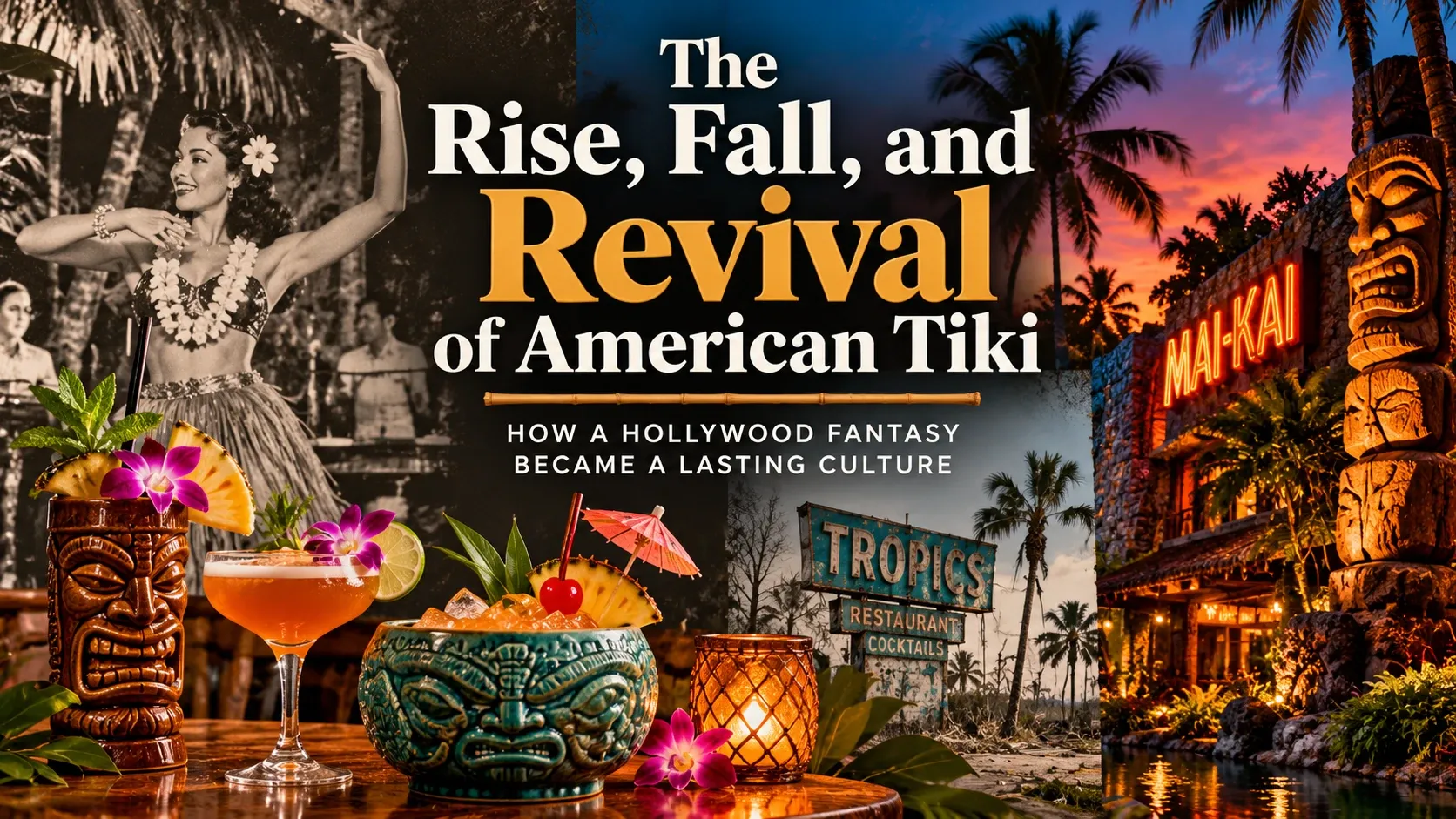
How a Depression-era escape became a midcentury obsession, slipped out of fashion, and returned with a new appreciation for its history.
Imagine walking into a restaurant in 1958 and discovering that the outside world has apparently ceased to exist.
The windows are hidden. The lights are low. Somewhere overhead, a glass fishing float glows against a ceiling of bamboo and woven matting. Water trickles through a tropical garden. A server arrives carrying a drink in a ceramic vessel unlike anything you have at home.
For a couple of hours, the ordinary world is somewhere beyond the front door.
Now imagine returning to that same address twenty years later. The restaurant is gone. The carved wood has been hauled away, the elaborate drinks have fallen out of fashion, and the building has become something entirely different.
That happened, in one form or another, to a remarkable number of America's tropical-themed restaurants.
And yet tiki never quite disappeared.
Today, bartenders study nearly forgotten recipes, collectors preserve old menus and mugs, and new bars invest extraordinary effort in creating their own immersive worlds. Historic establishments have survived, and in some cases, been rescued.
The story of American tiki isn't simply a rise, a fall, and a comeback. It's a story about changing American tastes, what people choose to preserve, and how a fantasy from another era gets reconsidered by a new generation.
If you're new to the subject, begin with our companion guide, What Is Tiki Culture? A Beginner's Guide to Polynesian Pop. Here, we're following the timeline itself.
Act One: The Rise
The 1930s: Selling an escape during the Depression
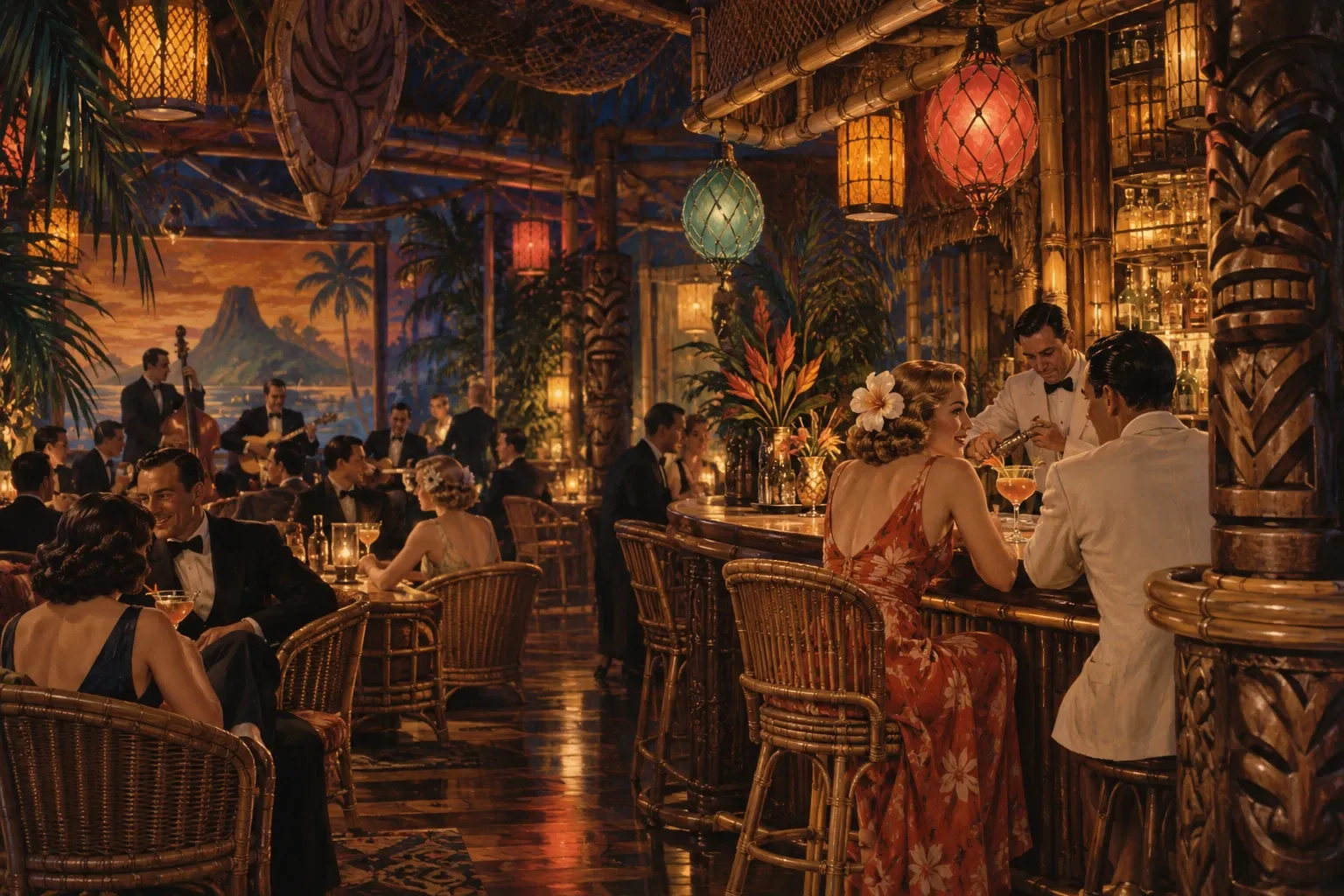
American tiki's roots stretch beyond the twentieth century. Adventure fiction, maritime travel, Hawaiian music, tourism, and romanticized stories about the South Pacific had already shaped the American imagination.
But an idea becomes something different when someone builds a place you can walk into.
In the early 1930s, Ernest Raymond Beaumont-Gantt, better known as Donn Beach, opened the Hollywood establishment that became Don the Beachcomber. Sources disagree on whether the opening is best dated to 1933 or 1934, but they agree on its importance.
Beach understood something about the experience people were buying. His customers didn't need a geography lesson. They wanted to leave their everyday concerns behind for an evening.
The theatrical setting delivered that promise. So did the cocktails.
These were not merely glasses of rum and fruit juice. Beach developed drinks with carefully layered spirits, citrus, syrups, and spices. The recipes demanded skill, preparation, and an understanding of how different flavors worked together.
The timing mattered. In the midst of the Great Depression, an elaborate tropical bar offered a form of imaginative travel that didn't require an ocean crossing.
It was a commercial fantasy, not a faithful representation of any Pacific Island society. That distinction would become more important as the movement grew.
Historical context: Smithsonian Magazine, “There's More to Classic Tiki Than Just Kitsch”
The late 1930s and 1940s: A formula becomes an industry
Donn Beach was not alone for long.
Victor Bergeron opened his Oakland bar Hinky Dinks in 1934. By 1938 it had taken on the identity of Trader Vic's, becoming another major force in tropical drinking and dining.
The two businesses had distinct personalities, but they helped establish the same larger proposition: a restaurant could be more than somewhere to eat.
The room, the drinks, the food, the service, and even the menu artwork could all contribute to a carefully orchestrated illusion.
Their success made the concept reproducible.
Other operators borrowed elements of the formula: low lighting, bamboo, dramatic roofs, carved objects, tropical landscaping, exoticized décor, and cocktails with names that promised adventure.
As those elements spread, they became a recognizable American design language.
The experience didn't need to take place beside the Pacific. In fact, much of its appeal came from encountering an imagined island escape in an ordinary American city.
Background: Smithsonian National Museum of American History, “Set of Tiki Glasses”
The 1950s: Why America went tiki-crazy
World War II changed the United States, its economy, and its relationship with the Pacific.
In the postwar decades, more families participated in an expanding consumer economy. Leisure spending, suburban entertaining, tourism, and destination dining became increasingly important parts of American life.
At the same time, the Pacific was more prominent in popular culture. Service members had encountered parts of the region during wartime, and travel, movies, music, advertising, and later the jet age placed tropical destinations in front of wider audiences.
American tiki benefited from all of those currents, but it did not accurately reflect the peoples and cultures represented in its imagery.
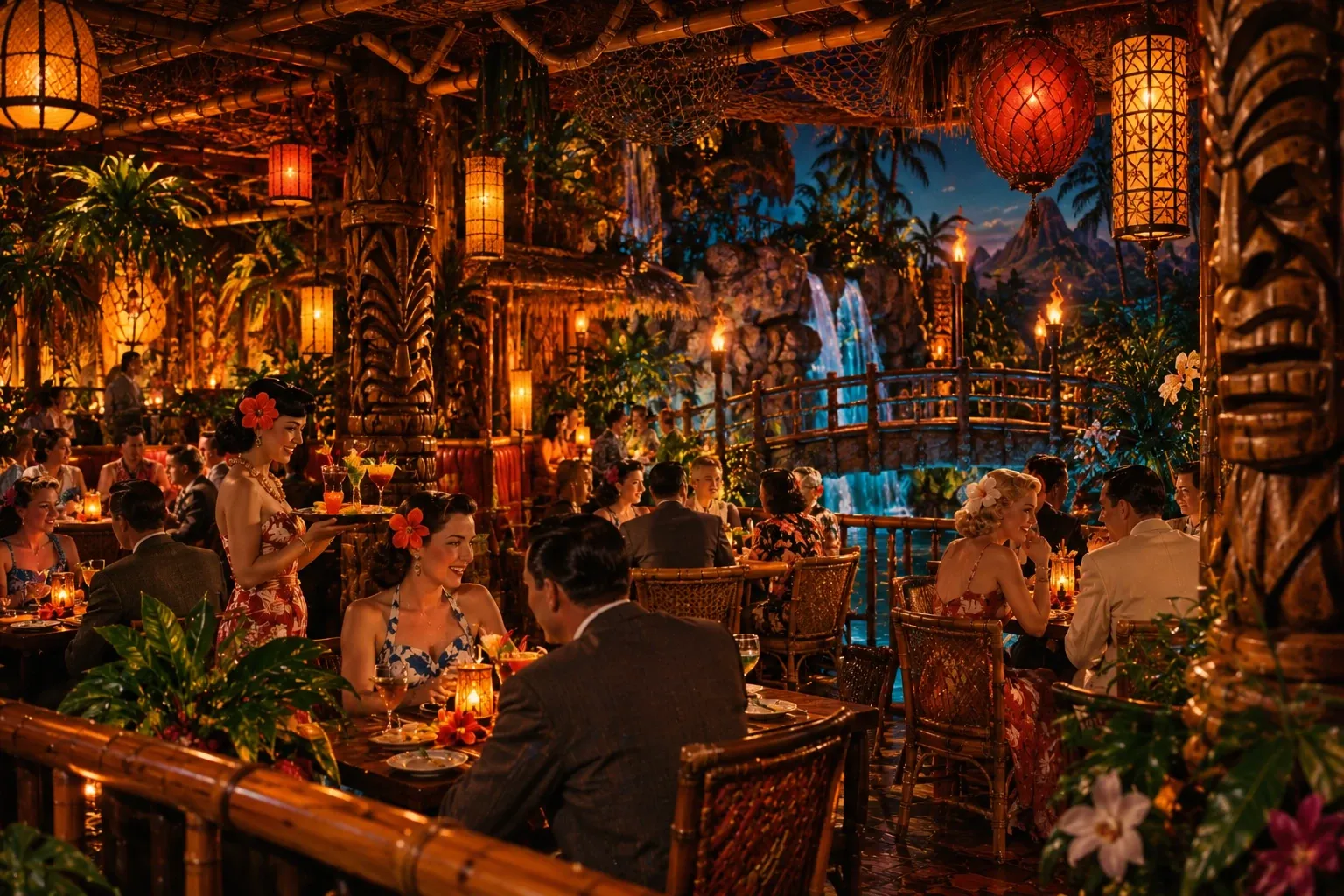
Restaurants created worlds that customers could enter without buying a plane ticket.
The atmosphere became more ambitious. Entrances were disguised. Gardens, waterfalls, carved figures, dramatic lighting, and intimate dining rooms helped turn an evening out into an event.
This was also the era when tiki escaped the restaurant.
A home patio could acquire bamboo furniture and a portable bar. A ceramic mug could become a souvenir. Tropical music and patterned shirts could extend the mood well beyond the dining room.
The Smithsonian's museum collections document how major restaurant groups such as Trader Vic's and Don the Beachcomber influenced smaller bars and home-entertaining traditions.
Tiki had stopped being just a restaurant concept. It had become a recognizable part of American leisure culture.
Florida's enduring example: The Mai-Kai
One of the clearest examples of the golden age is also one of the most important for us here in Florida.
The Mai-Kai in Fort Lauderdale opened in 1956.
Its ambition was extraordinary: immersive interiors, tropical cocktails, dining, and live entertainment combined into an evening designed to feel far removed from the everyday.
The Mai-Kai mattered because it treated the whole experience as the attraction, not simply the drink in front of you.
Decades later, its survival would also help tell the story of tiki's revival.
Historical and current venue source: The Mai-Kai
1963: Tiki moves into Disney's world of themed entertainment
In 1963, Walt Disney's Enchanted Tiki Room opened at Disneyland.
It wasn't a cocktail lounge, and it wasn't simply another tiki restaurant. But it belonged to the same era of fascination with imagined tropical environments.
It was also an important technological milestone: Disney's theatrical show introduced sophisticated Audio-Animatronics figures to park audiences.
Visitors entered a carefully designed setting where lighting, music, animated birds, flowers, and scenic details all contributed to a self-contained world.
The original concept had even been considered as a restaurant before Disney developed it into an attraction.
For anyone who loves both tiki design and Disney Imagineering, the connection is revealing. Midcentury Americans weren't merely buying tropical-looking objects. They were buying the pleasure of stepping inside a story.
Disney historical source: D23, “Enchanted Tiki Room”
Act Two: The Fall
The late 1960s and 1970s: When yesterday's paradise started looking dated
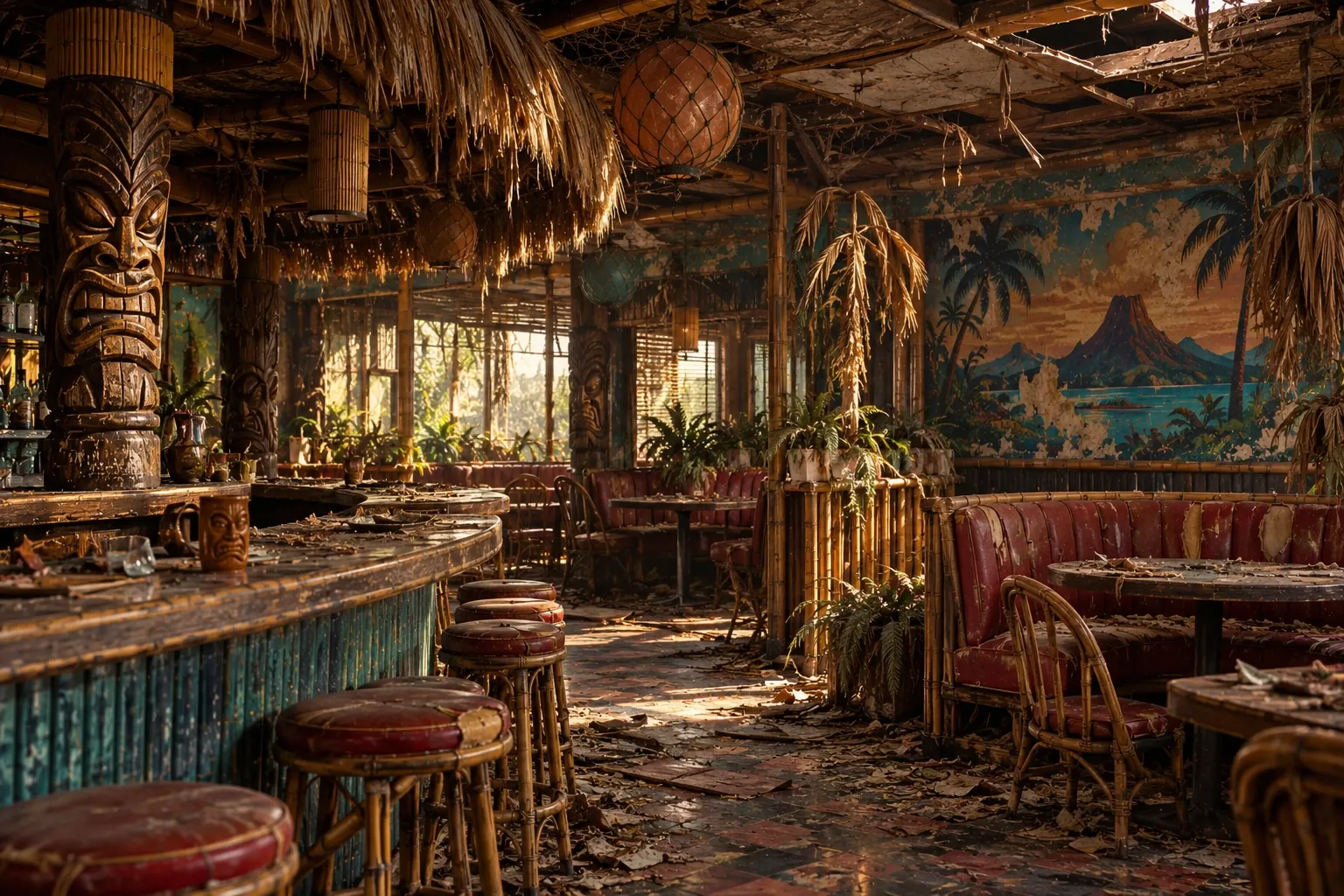
Tiki did not collapse on a single date.
Its popularity weakened unevenly as tastes changed, restaurants aged, and the culture around them evolved.
By the late 1960s, many younger Americans were questioning inherited assumptions about politics, race, colonialism, and representation. Idealized portrayals of Pacific Island peoples that had once passed largely unchallenged were increasingly open to criticism.
The design itself also began to look old-fashioned.
What had seemed glamorous in the 1950s could appear artificial or kitschy to a new generation. Drinking preferences changed. Some operators leaned on shortcuts and sweetened mixes rather than the more labor-intensive recipes that had distinguished early tropical cocktails.
Running a sprawling immersive restaurant was expensive. Maintaining gardens, interiors, lighting, elaborate service, and custom furnishings required a commitment that ordinary bars and restaurants didn't necessarily share.
Meanwhile, American diners had new choices.
The result wasn't one dramatic ending, but a gradual thinning of the landscape. Some establishments closed. Others remodeled, simplified their identities, or became shadows of what they had once been.
Historical discussion: Los Angeles Times, “Tiki Bars Are Built on Cultural Appropriation and Colonial Nostalgia”
Further context: Smithsonian Magazine's interview with Martin Cate
The problem with an imaginary paradise
It would be easy to explain tiki's decline entirely through changing décor trends.
That would leave out an essential part of the story.
American Polynesian Pop often combined imagery from different Pacific Island cultures without maintaining the distinctions between them. Some businesses treated sacred objects, symbols, and living traditions as decorative raw material.
The fantasy also emerged in a broader historical context of colonialism, tourism, and U.S. military activity in the Pacific.
Those concerns are not merely retrospective complaints about outdated fashion. They are questions about whose cultures were used to build the fantasy, who profited, and whose perspectives were left out.
In the Los Angeles Times, Native Hawaiian scholar Stephanie Nohelani Teves challenged the nostalgia that can surround tiki because that nostalgia overlooks colonial relationships and their continuing consequences.
Her perspective belongs in any serious history of the movement.
The artistry of a well-made cocktail and the historical significance of an immersive bar can be appreciated without defending every image, name, or assumption associated with the original scene.
In fact, understanding the tension makes the history more interesting, not less.
Source: John Birdsall's reporting and Pacific Islander perspectives in the Los Angeles Times
What survived the decline
Here is the part of the story I find especially compelling: tiki's survival depended on people who never quite accepted that it was over.
Some bars stayed open through decades of shifting tastes. The Tonga Hut in North Hollywood, established in 1958, and Tiki-Ti, opened in Los Angeles in 1961, are two well-known links to the earlier era.
The Mai-Kai continued to occupy a special place in Florida's hospitality landscape.
Elsewhere, collectors quietly gathered old menus, records, mugs, photographs, and architectural fragments. Bartenders and longtime patrons retained knowledge of recipes that were rarely written down in publicly available form.
These surviving places and objects became more than nostalgia.
They were evidence.
A mug could identify a vanished restaurant. A menu could reveal how a cocktail had been presented. A photograph could show an interior that no longer existed.
What looked like discarded kitsch to one generation became historical material for the next.
Surviving Los Angeles venues: Los Angeles Times tiki guide
Act Three: The Revival
The 1990s: Collectors become cultural historians
The modern tiki revival didn't begin with a wave of shiny new bars.
It began, in large part, with people searching for the remains of the old ones.
Interest in midcentury design, vintage Americana, lounge music, and forgotten roadside architecture brought a new audience to objects that had fallen out of fashion.
Sven A. Kirsten became especially important to the rediscovery of tiki's visual world.
His 2000 book The Book of Tiki assembled photographs, artifacts, architecture, and ephemera into a historical record of American Polynesian Pop.
The book helped readers see the movement as more than a collection of novelty mugs. It was a design and hospitality phenomenon with its own history, conventions, artists, and vanished landmarks.
Just as importantly, that documentation offered a starting point for people who wanted to restore or reinterpret the style.
Book reference: The Book of Tiki, TASCHEN, 2000
The lost recipes return
Another part of tiki history was hiding in plain sight: the drinks.
During the original era, some bartenders protected proprietary formulas through secrecy, coded instructions, or closely held preparations. When bars closed and the people who knew the recipes retired or died, that knowledge could disappear.
Jeff “Beachbum” Berry made it his mission to recover the original methods.
He searched vintage menus, books, and records and interviewed people connected to the earlier establishments. His Grog Log appeared in 1998; Sippin' Safari followed in 2007.
That research changed how people understood tiki drinks.
The original cocktails weren't just complicated because bartenders enjoyed adding ingredients. Their complexity came from deliberate blending, balance, and technique.
The revival also drew attention to bartenders whose contributions had been overlooked, including Filipino American professionals such as Ray Buhen, who worked at Don the Beachcomber and later founded Tiki-Ti.
Once those drinks could be studied and made with care again, bartenders had a reason to take tiki seriously beyond the décor.
Jeff Berry and early bartenders: Vogue, “The Tiki Bar Renaissance Has Arrived”
The 2000s onward: Tiki meets the craft cocktail movement
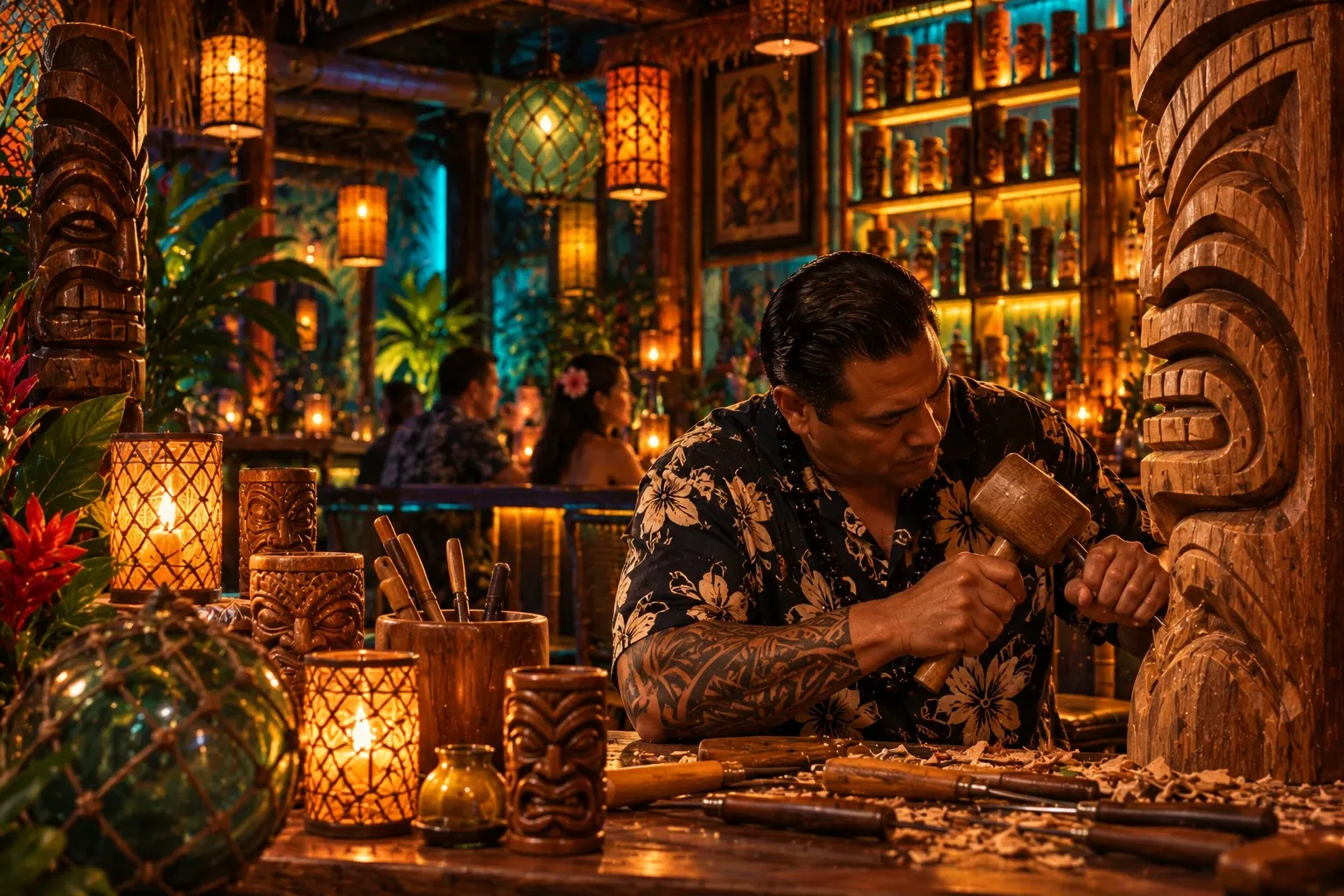
The rediscovery of original tropical recipes arrived alongside a broader interest in fresh ingredients, historic cocktails, better spirits, and more deliberate bartending.
That was a natural match.
Modern bars could embrace the theatrical qualities of tiki while giving equal attention to the liquid in the glass.
A well-executed rum blend, a properly made syrup, or a carefully balanced citrus component became a point of pride rather than a detail hidden behind a paper umbrella.
The revival also grew beyond cocktails.
Artists began creating new mugs and carvings. Designers developed richly themed home bars. Collectors shared research. Musicians revisited exotica and related midcentury sounds. Community events brought enthusiasts together.
Some projects aimed to preserve the look of the 1950s as closely as possible. Others used tiki's tradition of escapism as permission to invent something entirely new.
That's an important change.
The modern tiki experience no longer has to mean recreating the same fictional island paradise.
Contemporary revival reporting: Vogue, 2026
The Mai-Kai's restoration: A Florida landmark gets another chapter
The Mai-Kai gives this larger story a wonderfully concrete Florida ending.
After roof damage and a prolonged closure beginning in 2020, the Fort Lauderdale institution underwent an extensive restoration and reopened in November 2024.
The reopening mattered beyond the return of a beloved restaurant.
It showed that an immersive midcentury tiki destination could be considered worth restoring rather than replacing.
The building, interiors, cocktail traditions, and performance history represent a form of American hospitality heritage that would be difficult to recreate from scratch.
Not every historic tiki establishment had that opportunity.
For those that survive, the challenge is to preserve what makes them significant without pretending the surrounding cultural debates have disappeared.
Reopening coverage: Miami Herald, November 22, 2024
The Mai-Kai's official site
What the Revival Should Keep, and What It Should Reconsider
The best parts of tiki deserve to survive.
The cocktail craftsmanship. The imaginative design. The theatrical hospitality. The care required to make a room feel completely separate from the world outside.
So does the historical record: menus, photographs, buildings, artist credits, barware, recipes, and firsthand stories.
But preserving history isn't the same as repeating every part of it.
The modern scene has an opportunity to move beyond generic images of an invented “South Seas,” to be more accurate about cultural origins, and to recognize the work of Pacific Islander artists and communities as something far richer than restaurant decoration.
Not everyone agrees on what an appropriate contemporary tiki bar should look like. Some favor historical preservation, some advocate substantial changes, and some question whether the term or aesthetic should continue at all.
Those aren't questions that a new mug design or an excellent Mai Tai can settle.
What an enthusiast can do is approach the history with curiosity instead of defensiveness, appreciate the craft without erasing the harm, and make thoughtful choices about the spaces and creators they support.
There is still plenty of room for escape, atmosphere, and joy.
The difference is that we can understand more about the fantasy we're entering.
A Short Timeline of American Tiki
| Period | What changed |
|---|---|
| Early 1930s | Don the Beachcomber introduces an influential Hollywood tropical-bar experience. |
| 1934–1940s | Trader Vic's develops its own style and helps popularize tropical dining and cocktails. |
| 1950s–early 1960s | The movement spreads through destination restaurants, suburban entertaining, design, music, and popular culture. |
| 1956 | The Mai-Kai opens in Fort Lauderdale. |
| 1963 | Disneyland opens Walt Disney's Enchanted Tiki Room. |
| Late 1960s–1980s | Mainstream enthusiasm weakens; closures and remodels reduce the number of elaborate originals. |
| 1990s | Collectors, historians, and bartenders begin documenting tiki's visual history, and Jeff “Beachbum” Berry's Grog Log (1998) starts the recovery of forgotten cocktail recipes. |
| 2000 | Sven Kirsten publishes The Book of Tiki. |
| 2001 | Tiki Oasis begins in Palm Springs and grows into the revival's best-known gathering. |
| 2009 | Smuggler's Cove opens in San Francisco and sets the benchmark for craft-cocktail tiki bars. |
| 2011 | Trader Sam's Enchanted Tiki Bar opens at the Disneyland Hotel, bringing Disney back to tiki nearly 50 years after the Enchanted Tiki Room. |
| 2013 | Three Dots and a Dash opens in Chicago, carrying the revival into big-city nightlife. |
| 2014 | Jeff “Beachbum” Berry, the historian behind many recovered recipes, opens Latitude 29 in New Orleans. |
| 2015 | Trader Sam's Grog Grotto opens at Disney's Polynesian Village Resort in Florida. |
| 2017 | Martin and Rebecca Cate's book Smuggler's Cove wins a James Beard Award. |
| 2018 | Devil's Reef opens in Tacoma, Washington, as the revival spreads well beyond the big-city hubs. |
| 2020 | The Mai-Kai closes after serious damage, beginning a four-year restoration. |
| 2024 | The restored Mai-Kai reopens in Fort Lauderdale. |
| Today | Historic institutions, craft cocktail bars, collectors, artists, and communities continue to reinterpret the tradition. |
Frequently Asked Questions
When did tiki culture become popular in America?
The modern American tropical cocktail-bar movement began in the 1930s, but its largest cultural expansion came in the postwar years, especially the 1950s and early 1960s.
Why did tiki bars lose popularity?
There was no single cause. Changing design and drinking tastes, the expense of maintaining elaborate restaurants, and increasing criticism of stereotyped Pacific Island imagery all contributed to a long, uneven decline.
When did the tiki revival start?
Collectors and enthusiasts began helping revive interest by the 1990s. Historical research, new books, and the craft cocktail movement helped broaden that revival through the 2000s and beyond.
Did tiki culture completely disappear?
No. Historic bars such as Tiki-Ti and the Mai-Kai, alongside longtime bartenders, collectors, and other enthusiasts, maintained important connections to the earlier tradition.
Is modern tiki the same as Polynesian culture?
No. American tiki, often called Polynesian Pop, is a commercial entertainment and design tradition. Native Hawaiian and other Pacific Island cultures are living cultures with their own distinct histories, identities, and practices.
The Part of Tiki History Worth Carrying Forward
I understand the appeal of the old places.
There is something extraordinary about walking into a room where somebody has thought about every lamp, every carved detail, every sound, every corner, and every drink.
That kind of attention makes ordinary hospitality feel like an adventure.
But the longer I explore tiki, the more interested I become in the people who kept its history alive when almost nobody else cared: the bartenders who remembered recipes, the collectors who rescued menus, the historians who tracked down photographs, and the owners who kept historic doors open.
Without them, we'd have fewer places to visit, fewer stories to tell, and far less understanding of how this unusual American movement developed.
The original tiki era can't be brought back exactly as it was, and perhaps it shouldn't be.
What we can preserve is its creativity, its craftsmanship, its talent for immersion, and a more honest understanding of where it came from.
That's a revival worth raising a glass to.
If this history has you curious about the world beyond the cocktail, explore our Tiki & Hawaiiana collection. And if you're ready to see how the tradition lives on in the Sunshine State, start with Florida's Real Tiki Bars and the Florida Tiki Trail.
Adventure looks better in a Hawaiian shirt.