
Field Notes · October 19, 2026 · Onboard
Disney Cruise Kids Clubs: Oceaneer Club, Edge, Vibe & Nursery Guide
Oceaneer Club, Edge, Vibe, Nursery Care & What Parents Actually Need to Know
One of the strangest moments on a Disney cruise happens when your child realizes:
they may have more interesting plans than you do.
You imagined a family vacation.
Breakfast together.
Pool together.
Characters together.
Dinner together.
Shows together.
Then you introduce them to Disney's kids clubs.
And suddenly you're standing outside Disney's Oceaneer Club negotiating visitation rights.
This is not a complaint.
This is one of Disney Cruise Line's biggest advantages.
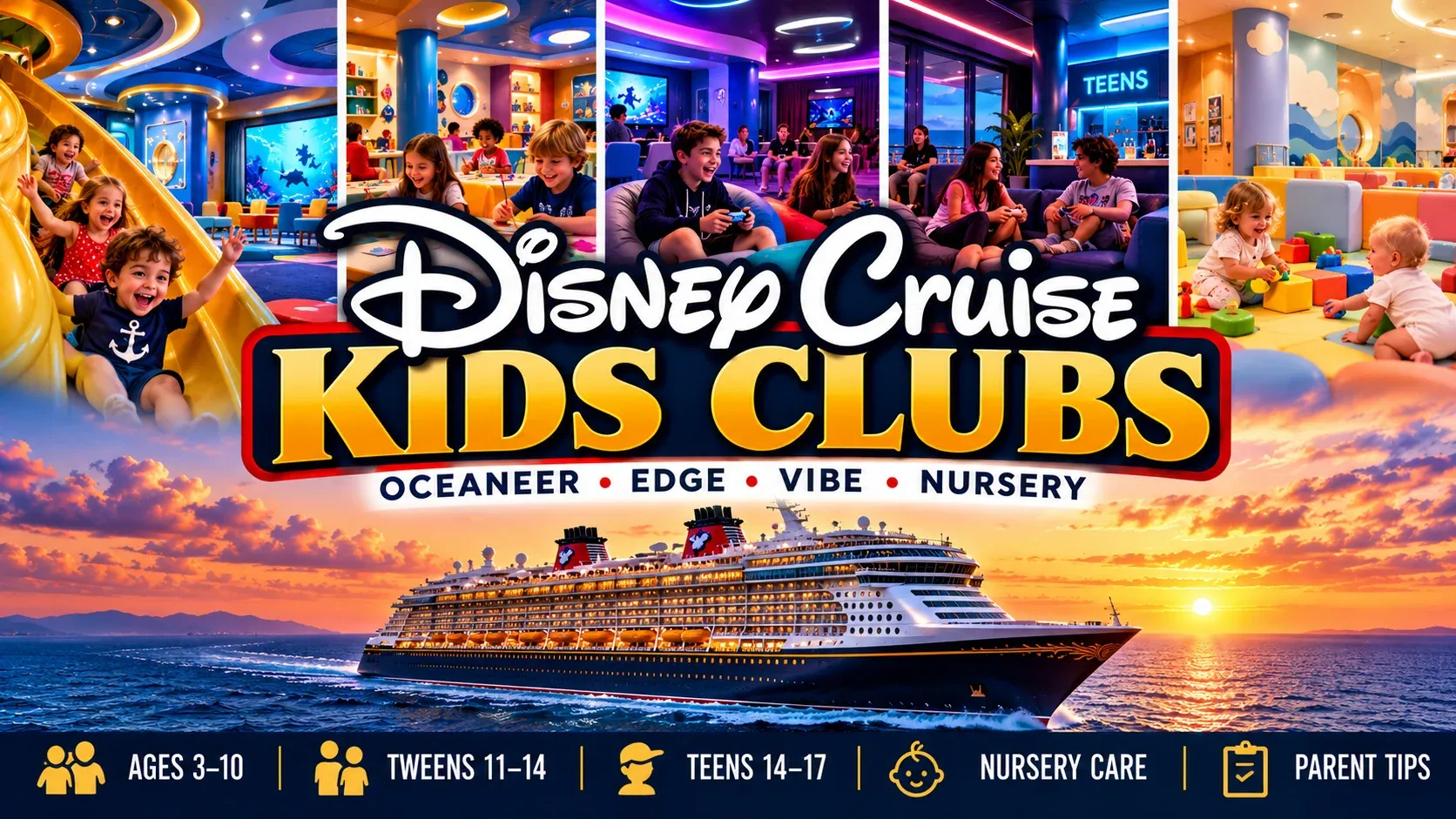
The youth spaces aren't merely somewhere to leave children while adults go do something else. Disney has built an entire age-based onboard ecosystem that currently includes Disney's Oceaneer Club, Oceaneer Lab on the four classic ships, Edge, Vibe and "it's a small world" nursery! Disney currently lists Oceaneer Club for ages 3 to 10, Edge for ages 11 to 14 and Vibe for ages 14 to 17.
For families?
That changes the entire cruise.
The Quick Answer
Disney Cruise Line currently divides its core youth programming roughly like this:
| Age | Main Disney Cruise Youth Space |
|---|---|
| 6 months to 3 years | "it's a small world" nursery! |
| 3 to 10 | Disney's Oceaneer Club |
| 3 to 10 | Disney's Oceaneer Lab on Magic, Wonder, Dream and Fantasy |
| 11 to 14 | Edge |
| 14 to 17 | Vibe |
| Older teens / young adults on select ships | The Hideaway during designated programming |
Disney requires children using Oceaneer Club or Oceaneer Lab during secured programming to be ages 3 to 10 and fully toilet trained. During scheduled Open House periods, guests of all ages can visit the youth spaces together.
The nursery is different.
It provides paid group childcare for younger children and requires reservations because capacity is limited.
And the most important thing parents should understand?
You do not have to use any of it.
But if your child loves the clubs?
Your Disney cruise changes dramatically.
Disney's Oceaneer Club
This is the heart of Disney's kids programming.
Disney's Oceaneer Club is designed for children ages 3 through 10. Disney describes it as the more storytelling-oriented side of its youth program, with themed play spaces and interactive experiences.
The exact environment depends heavily on the ship.
That's important.
There isn't one universal Oceaneer Club duplicated eight times.
Different ships can feature different themed spaces, activities and layouts.
This makes kids clubs another legitimate factor when choosing a ship.
Oceaneer Club vs Oceaneer Lab
This confuses first-time cruisers.
Disney's own explanation is useful:
Oceaneer Club emphasizes storytelling and immersive play.
Oceaneer Lab emphasizes creating, discovering and exploring.
Both currently serve children ages 3 to 10 during regular secured programming.
But Oceaneer Lab is currently listed aboard:
- Disney Magic
- Disney Wonder
- Disney Dream
- Disney Fantasy
Disney's newer ships use different youth-space designs instead of duplicating that classic Club + Lab arrangement.
So if somebody tells you:
"The kids just go back and forth between Club and Lab."
That may be correct for their ship.
It is not a fleet-wide statement anymore.
Can Children Move Between Oceaneer Club and Lab?
On ships where both operate, yes.
Disney says the two spaces are connected, and children may move between them during portions of the day. Youth counselors can direct or escort children between the spaces when needed.
That gives kids more freedom than parents sometimes expect.
They may start in one area.
Find an activity somewhere else.
Move.
Meet another group.
Change plans.
This is approximately when parents discover their eight-year-old has acquired a more complicated social calendar than they have.
Children Ages 3 and 4
This age deserves special attention.
Disney currently says children ages 3 and 4 can participate in guided activities created specifically for them within Oceaneer Club and Lab programming.
That matters because there can be a huge developmental difference between:
a newly three-year-old
and
a ten-year-old.
Disney groups a wide age span under the Oceaneer umbrella, but there are activities intended to make the younger end of that range more manageable.
Still?
Know your child.
Some three-year-olds will march into the club without looking back.
Others will react as though you've proposed abandoning them in international waters.
Both are normal.
Toilet Training Rules
This one is not negotiable.
Disney currently requires children using Oceaneer Club and Oceaneer Lab during secured programming to be fully toilet trained.
If your child does not meet that requirement?
They can still visit during designated Open House periods when the spaces are available to guests of all ages.
But they cannot participate in the regular secured drop-off programming.
This is something I would confirm before the cruise.
Not at the check-in desk while standing beside a disappointed preschooler.
Open House Is Your Friend
One of the best things Disney offers is scheduled Youth Activities Open House time.
During Open House, family members can enter youth spaces together, including areas such as Oceaneer Club, Oceaneer Lab, Edge and Vibe.
This is especially valuable on embarkation day.
My recommendation?
Go.
Let your child see the space with you.
Explore.
Play.
Meet counselors if possible.
Figure out where things are.
Then later, when you suggest going back alone, the environment is no longer completely unfamiliar.
That is a much easier transition.
The Embarkation Day Strategy
I would make the youth club tour one of the first-day priorities for families planning to use the clubs.
Not because you need to spend hours there.
Because familiarity matters.
Your child gets to see:
where they'll enter,
what the space looks like,
what interests them,
whether it feels exciting,
and whether they're actually comfortable.
You also get to see it.
Parents tend to become dramatically more relaxed after they understand where their child is going.
This is useful.
Especially when Disney has built some of these spaces so well that your reaction may become:
Wait. Why can't I stay here?
Disney Wish, Treasure and Destiny Kids Clubs
Disney's newer Wish-class ships moved heavily toward immersive themed spaces.
Instead of treating the club as one big generic children's room, the design philosophy feels much closer to:
miniature Disney attractions that happen to contain youth programming.
That is part of what makes ship selection interesting for families.
Wish, Treasure and Destiny share the broader Wish-class design DNA, but the ships still have their own thematic differences elsewhere onboard.
For children who care deeply about immersive Disney environments?
These ships can be especially compelling.
The Slide Into Oceaneer Club
One of the signature Wish-class features is that children can enter Disney's Oceaneer Club from the Grand Hall using a slide.
Which is objectively a better entrance than:
door.
This is one of those tiny Disney details that immediately tells children:
This part of the ship belongs to you.
Adults may use a normal entrance.
Because adulthood remains disappointing.
Marvel Super Hero Academy
Disney's newer Oceaneer spaces can incorporate Marvel-themed programming and environments.
For Marvel-loving children, this can be one of the biggest differences between:
going to childcare
and
wanting to go back to the club.
That psychological distinction is enormous.
If the club feels like somewhere the adults are sending you?
Different experience.
If it feels like somewhere you are leaving the adults to go?
Success.
Fairytale Hall and Disney Storytelling
The newer club designs also lean into Disney storytelling environments.
That can include princess-focused spaces and other familiar Disney worlds depending on the ship.
Again, this is why I wouldn't tell every family:
Book the newest ship.
I'd tell them:
Look at the specific spaces.
Which themes will your children actually care about?
A child obsessed with Toy Story may respond differently to one ship than a child obsessed with Marvel.
Vacation planning improves when we stop pretending children are generic units.
Classic Ships Still Have Excellent Kids Clubs
Do not assume:
newer = automatically better.
Disney Magic, Wonder, Dream and Fantasy still have established youth programming, and the Club + Lab combination gives children a broad mix of imaginative play and hands-on activities.
Disney's current Oceaneer Lab listing remains specific to those four ships.
The classic ships also have another advantage:
they can feel easier to navigate.
For some families, especially with younger kids?
Smaller and familiar beats newer and enormous.
Disney Wonder Example
Disney Wonder currently features a Toy Story-themed Andy's Room within Oceaneer Club, where Disney describes children ages 3 to 10 playing in a larger-than-life version of Andy's room.
That's a good example of what makes Disney youth spaces different.
The design isn't:
televisions + beanbags + crafts.
It's:
you walked into the movie.
That emotional connection matters.
Edge
Then children become tweens.
And everything changes.
Disney currently positions Edge for ages 11 to 14. It is built around socializing, games, music, technology, karaoke, scavenger hunts, themed evenings and other tween programming.
The tone is completely different from Oceaneer Club.
As it should be.
An eleven-year-old generally does not want to be treated like a five-year-old.
And a fourteen-year-old definitely does not want you reminding them that they enjoyed meeting Mickey yesterday.
They did.
They just don't want witnesses.
Edge Is About Independence
This is probably the biggest shift.
Oceaneer Club feels like supervised children's programming.
Edge begins feeling more like:
their space.
Tweens meet other kids.
Hang out.
Participate in activities.
Decide what sounds interesting.
Socialize without parents hovering over every interaction.
For some children?
This becomes the highlight of the entire cruise.
For others?
Walking into a room full of strangers sounds approximately as appealing as public speaking.
Again:
know your child.
The First Night Matters for Tweens
If your tween wants to use Edge?
I would strongly encourage them to check it out early.
Friend groups form quickly on cruises.
Not because people are intentionally excluding newcomers.
Because everyone is living in the same floating neighborhood for a few days and naturally starts connecting.
A tween who waits until Day 4 of a seven-night cruise may walk into a room where everybody already seems to know one another.
Not impossible.
Just harder.
Early is easier.
Vibe
Disney currently positions Vibe for teens ages 14 through 17.
Vibe is deliberately separate from younger children's programming.
Think:
music.
movies.
games.
social spaces.
teen activities.
themed nights.
and a place where teenagers can exist without feeling like they've been enrolled in family bonding camp.
This matters.
Teenagers can absolutely enjoy Disney Cruise Line.
But Disney has to give them something beyond:
princesses and character breakfasts.
Vibe helps solve that problem.
The Edge and Vibe Age Overlap
Notice something?
Edge is currently:
11 to 14
Vibe is:
14 to 17
That means age 14 sits in an interesting overlap under Disney's current published age guidance.
That can be useful for families traveling with a fourteen-year-old whose maturity, friend group or preferences may make one environment more appealing than another.
But don't build assumptions from an old forum post.
Check your sailing and Disney's current youth programming rules.
Age policies are exactly the kind of detail cruise lines can change.
The Hideaway
Disney Wish, Treasure and Destiny also feature The Hideaway.
Disney describes it as a space for older teens and young adults to relax, socialize, listen to music and participate in activities such as karaoke.
Programming and age access can depend on the scheduled use of the space.
This is not simply:
another permanent teen club identical to Vibe.
Think of it as additional flexible space that can support older-teen and young-adult programming.
And on longer cruises?
That extra social environment can become especially valuable.
"it's a small world" Nursery!
Now we get to the babies and toddlers.
Disney currently offers "it's a small world" nursery! on all eight ships, including Disney Adventure.
Disney's current ship pages and youth guidance describe nursery care for little ones starting at approximately 6 months through age 3.
Unlike the standard youth clubs?
The nursery is not included in the base cruise fare.
It is paid childcare.
And reservations matter.
Nursery Reservations
Disney explicitly says nursery space is limited and recommends booking as early as possible.
This is one of the things I would actually plan before sailing.
Especially if you know you want:
Palo.
Enchanté.
Spa time.
An adult excursion window.
Quiet Cove.
or simply:
ninety consecutive minutes where nobody asks you for a snack.
If nursery time matters to the vacation?
Do not treat it like something you'll casually arrange onboard after everyone else had the same idea.
Can You Use the Nursery While the Ship Is in Port?
Disney currently says yes.
Group babysitting can be available while the ship is in port, subject to nursery operating hours and availability.
That creates possibilities.
But personally?
I would think carefully before leaving a very young child onboard while adults go ashore.
Not because Disney doesn't permit it.
Because you need to be comfortable with the practical reality that you may be physically off the ship and potentially some distance away.
Families will make different choices here.
That's okay.
Nursery vs Oceaneer Club
These are fundamentally different systems.
Nursery
- younger children
- paid
- reservation-based
- limited availability
- childcare-focused
Oceaneer Club / Lab
- ages 3 to 10
- included
- secured youth programming
- child must meet age and toilet-training requirements
That distinction matters.
A newly three-year-old may technically sit near the transition point.
But eligibility isn't simply:
birthday happened, problem solved.
The toilet-training requirement applies to Oceaneer programming.
Can Parents Stay in the Kids Clubs?
During normal secured programming?
No.
That defeats the entire secured-youth-space concept.
During scheduled Open House?
Yes.
That's when families can explore together.
This is why Open House is so valuable.
Parents get to see what they're trusting.
Children get to explore with a familiar person.
Then the regular programming can actually function as intended.
How Secure Are the Kids Clubs?
Disney operates secured youth programming with trained counselors and age-based access rules.
Parents should follow the current registration, check-in and pickup procedures for their ship and sailing.
This is also where I would resist relying on a ten-year-old blog post describing:
exact wristbands,
exact scanners,
exact pickup procedures.
Those operational details can evolve.
Use current Disney instructions.
What About Children With Disabilities?
This needs more careful treatment than generic:
Disney is great with everyone.
Disney says children using Oceaneer Club or Lab during secured programming must be able to participate within the counselor-to-child group structure and interact within the program without requiring one-on-one care. Disney specifically notes that youth staff cannot provide one-on-one care or counselor-assisted medical attention.
Disney encourages families with questions to contact Special Services before sailing.
That matters.
Parents deserve the actual policy before making assumptions.
Sensory and Social Considerations
Even when a child is eligible?
Eligibility does not automatically mean:
comfortable.
Youth clubs can be:
busy.
social.
stimulating.
noisy.
unfamiliar.
Some children will thrive.
Some will need breaks.
Some may prefer Open House with family.
Some will never want to leave.
The successful strategy isn't forcing the kid into the experience you imagined when booking.
It's noticing what actually works for them.
What If My Child Refuses to Go?
Then they don't go.
I realize this is disappointing if you pictured:
kids club + Palo = sophisticated adult evening.
But dragging a miserable child into a youth club because:
“Disney Cruise Line is famous for this!”
does not improve anyone's vacation.
Try Open House.
Try another day.
Let them look around.
Maybe something clicks.
Maybe not.
A Disney cruise still contains a lot of family activities.
The kids club is an option.
Not mandatory curriculum.
What If My Child Never Wants to Leave?
Now we have the opposite problem.
Congratulations.
You have apparently paid thousands of dollars to transport your child somewhere they would prefer you not visit them.
This happens.
Especially once children:
make friends,
discover favorite counselors,
find a game or activity,
or become attached to a particular space.
My advice?
Let them enjoy it within reason.
You do not need to maintain a perfect percentage of family time to qualify as having taken a family vacation.
The Family Vacation Guilt Problem
Parents sometimes feel weird about dropping kids at the clubs.
You spent all this money to travel together.
Shouldn't you:
be together?
Not every second.
Family vacations can work better when everyone gets something specifically for them.
Child gets Oceaneer Club.
Teen gets Vibe.
Adults get Palo.
Then everybody comes back together at dinner with something to talk about.
That can be healthier than dragging the entire family through identical activities twelve hours a day because:
we are making memories.
Under duress.
Kids Clubs During Dinner
This can be a good strategy.
Depending on operating schedules and your child's preferences, kids club time can give adults space to:
have a longer dinner,
visit a lounge,
book premium dining,
or simply talk.
But I would not automatically eliminate rotational dining as a family.
Disney dining itself can be a major part of the cruise experience.
Especially on the newer ships.
Balance it.
Kids Clubs During Sea Days
Sea days are when youth clubs become especially valuable.
The entire ship is onboard.
Activity schedules expand.
Families are looking for things to do.
The clubs provide another dimension beyond:
pool.
food.
movie.
repeat.
This is particularly useful on:
seven-night cruises,
Alaska,
Transatlantic voyages,
and other itineraries with meaningful ship time.
Kids Clubs During Port Days
Also possible.
But again, think about your family's comfort level if adults intend to leave the ship.
For an older child staying onboard in a secured youth program?
Some parents are completely comfortable.
Others are not.
With very young children in the nursery?
Same issue, only amplified.
Disney may allow the arrangement.
That does not mean every parent will want it.
Does Using the Kids Clubs Cost Extra?
For standard Oceaneer Club, Oceaneer Lab, Edge and Vibe programming?
These are part of Disney's included youth-club offering.
The nursery is different and carries an additional fee. Disney explicitly identifies nursery babysitting as an extra-cost service.
Other premium children's experiences, such as Bibbidi Bobbidi Boutique, are also separate paid experiences.
Do not mentally combine:
kids club
with
every child-focused thing on the ship.
Disney has monetization departments too.
Bibbidi Bobbidi Boutique Is Not a Kids Club
Worth saying.
Disney currently offers Bibbidi Bobbidi Boutique for children ages 3 to 12 on supported ships, with additional themed transformations such as Pirates League available on select Pirate Night sailings.
That is a reservation-based premium experience.
Not drop-off youth programming.
Different category.
Different budget line.
Different likelihood that your child suddenly requests an expensive costume.
How Long Can Kids Stay?
This depends on:
operating hours,
scheduled programming,
the ship,
the day,
and your child's tolerance.
The Navigator app is your friend.
But my philosophy is:
do not optimize for maximum duration.
Optimize for:
child genuinely enjoying themselves.
If they're happy for an hour?
Great.
If they're happy for four?
Also great.
If they want to leave after twelve minutes?
Well.
That happened too.
Should Siblings Stay Together?
Maybe.
One of the advantages of the broad Oceaneer age range is that eligible siblings can potentially share the same broader youth environment.
But they don't necessarily need to spend every minute together.
If one child finds:
Marvel.
and the other finds:
crafts.
let them split.
This is one of those rare vacation environments designed to give children some independence while still keeping them inside controlled youth spaces.
Use it.
What Should Kids Bring?
Generally?
Not much.
This is not summer camp.
You don't need to pack a backpack full of entertainment for Oceaneer Club.
The entertainment is the point.
I would make sure they have what Disney currently requires for check-in and follow whatever guidance appears in your cruise documentation.
For the nursery, Disney provides specific preparation guidance, and parents should review those instructions before sailing.
Again:
current cruise documentation beats somebody's 2019 packing list.
Should Kids Bring Phones?
Depends on age and family rules.
Older kids and teens may use devices for communication and the Navigator app where appropriate.
Younger children?
Probably less important.
But this is where your family should establish expectations before embarkation:
Can they move around independently?
When do they need to check in?
Can they return to the room?
Where do you meet?
What happens if plans change?
Cruise freedom is excellent.
Cruise freedom with absolutely no family communication plan is less excellent.
Edge and Vibe for Shy Kids
This can be tricky.
The advice:
"Just go make friends!"
has never helped a shy human in recorded history.
Instead?
Encourage them to visit early.
Stay briefly.
Try one scheduled activity.
Give them an exit option.
If they connect with someone?
Excellent.
If not?
There are plenty of other things to do onboard.
The youth clubs should expand the vacation.
Not become another social obligation.
Which Disney Ship Has the Best Kids Club?
There is no universal winner.
But there are broad patterns.
Wish, Treasure and Destiny
Best if you value:
immersive newer environments,
highly themed spaces,
the Grand Hall slide entrance,
and newer Disney intellectual property.
Dream and Fantasy
Strong for:
large-ship amenities,
classic Club + Lab structure,
AquaDuck,
and established family programming.
Magic and Wonder
Strong for:
smaller-ship navigation,
classic Disney Cruise atmosphere,
Club + Lab,
and families who prefer something more intimate.
Disney Adventure
A different product entirely, with its own scale, entertainment philosophy and youth environments.
The correct question isn't:
Which kids club is best?
It's:
Which kids club fits my child?
Best Kids Club for a 4-Year-Old
I would prioritize:
comfort.
manageable scale.
early familiarization.
age-appropriate guided activities.
and whether the child actually likes being separated from you.
A spectacular themed room is irrelevant if your child is standing at the entrance saying:
absolutely not.
Best Kids Club for an 8-Year-Old
This is probably the youth-program sweet spot.
They're old enough to:
explore.
participate independently.
understand the activities.
make friends.
and appreciate the theming.
Yet they're still right in the heart of the Oceaneer age range.
For many families, this is when Disney's youth-club advantage becomes very obvious.
Best Club for a 12-Year-Old
Edge.
This is exactly why Edge exists.
A twelve-year-old often wants:
more freedom.
less little-kid theming.
other kids their age.
games.
music.
social time.
Give them their own territory.
Best Club for a 16-Year-Old
Vibe.
If they want it.
That's the important qualifier.
Some sixteen-year-olds will meet people immediately and disappear into teen programming.
Others would rather spend time:
at movies,
with family,
around the ship,
or doing something else entirely.
Teenagers remain inconveniently individual.
Why the Clubs Matter for Parents
Now we get to the secret.
Disney's kids clubs don't only benefit kids.
They create the conditions for adults to experience the adult side of Disney Cruise Line.
Suddenly you can have:
Palo.
Enchanté.
Quiet Cove.
Spa.
A cocktail.
A long conversation.
An hour where nobody asks:
"What are we doing next?"
That adult time can materially improve the family vacation.
Because rested parents tend to be more enjoyable parents.
An exciting scientific discovery.
Kids Clubs and Adult Dining
This is one of the best combinations.
Especially on a longer sailing.
If your children genuinely enjoy the youth clubs, you can schedule an adult dinner without feeling like you're abandoning them while they stare at a hotel-room television.
They're doing something they wanted to do.
You're doing something you wanted to do.
Everyone wins.
Then the bill arrives at Enchanté.
Disney wins too.
Kids Clubs and Multigenerational Trips
This is another reason Disney can work well for extended families.
Grandparents do not need to entertain children every minute.
Parents do not need to coordinate every activity.
Children can have youth programming.
Adults can split into different experiences.
Then everyone reconnects.
Multigenerational travel becomes easier when the ship can absorb different interests.
That is one of cruising's biggest structural advantages.
The Biggest Kids Club Mistake
Telling your child:
"You're going to love it."
Maybe they will.
You don't know yet.
A better approach?
Show them.
Visit during Open House.
Talk about what's available.
Let them try it.
Then respond to what actually happens.
You are reducing pressure.
Not selling a timeshare.
The Second Biggest Mistake
Waiting too long to introduce tweens and teens to Edge or Vibe.
Younger kids don't care much if they join Oceaneer Club on Day 3.
Teen social spaces can be different.
Relationships start forming early.
If your teen is remotely interested?
Encourage the first-night visit.
Then let them decide.
The Third Biggest Mistake
Using the clubs as compulsory childcare.
If your kid is miserable?
Stop.
The point is not:
we paid for this, therefore you must use it.
The point is:
Disney created another potentially great experience.
Potentially.
That's the word.
Tiki Tim's Kids Club Rule
Give children enough space to have their own vacation.
Not a separate vacation.
Their own version of the same trip.
Maybe your favorite memory is dinner at Palo.
Maybe theirs is making friends at Edge.
Maybe you loved Castaway Cay.
Maybe they still won't stop talking about whatever happened inside Oceaneer Club that they're explaining badly at breakfast.
That's okay.
You don't need identical favorite moments.
You just need everyone to come home thinking:
that was a great trip.
Are Disney Cruise Kids Clubs Worth It?
Yes.
They are one of Disney Cruise Line's strongest differentiators for families.
Disney currently provides a structured progression from nursery care through Oceaneer Club, Edge and Vibe, with age-specific spaces designed for babies, children, tweens and teens across the fleet.
But the real value isn't:
free babysitting.
It's that Disney gives different members of the same family permission to enjoy the ship differently.
That makes the entire vacation more flexible.
And for families?
Flexibility is usually worth more than another activity.
Keep exploring: Onboard Experiences Hub, Best Disney Ship for Families, Disney Wish Guide, Disney Treasure Guide, Disney Destiny Guide and Dining Guide.