
Field Notes · October 19, 2026 · Itineraries
Disney Transatlantic Cruise Guide: Sea Days, Ports & Who It's Best For
Sea Days, Europe, One-Way Travel & Who Should Actually Book One
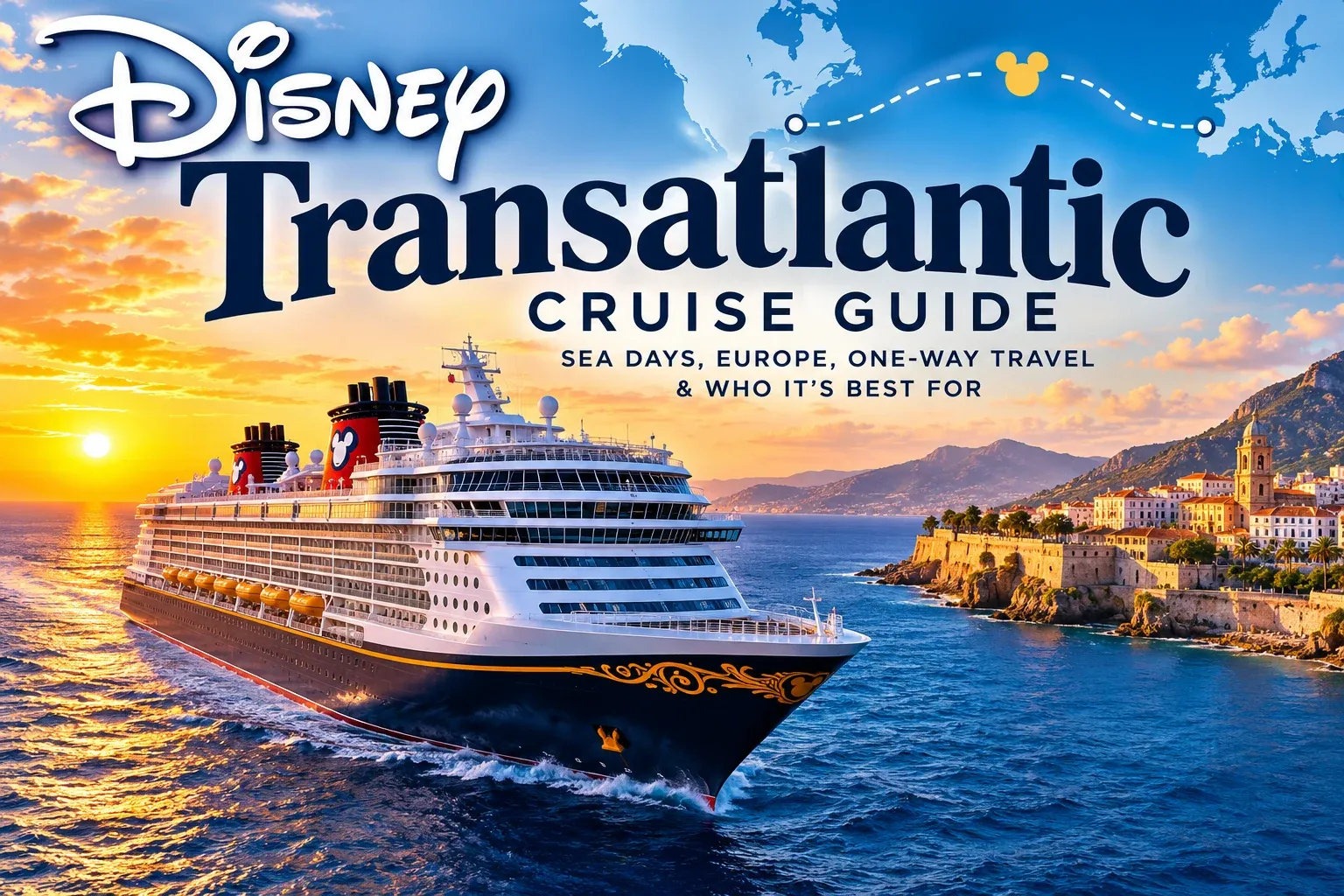
A Disney Transatlantic cruise is not a normal cruise with a few extra nights added.
It is a completely different style of travel.
You are not hopping between islands every morning.
You are not spending four nights deciding whether Nassau is worth getting off the ship for.
You are crossing an ocean.
That means:
long stretches at sea,
fewer ports,
more time onboard,
one-way travel logistics,
and enough days on the ship that you eventually stop treating every activity like an appointment.
For the right traveler?
That sounds incredible.
For the wrong traveler?
Nine sea days may start feeling like you're serving a sentence with excellent rotational dining.
So before booking one, you need to understand what a Disney Transatlantic cruise actually is.
The Quick Answer
A Disney Transatlantic cruise is especially good for travelers who:
- already know they enjoy cruising
- love sea days
- want a longer vacation
- want unusual European or Atlantic ports
- care about the ship itself
- enjoy slower travel
- can handle one-way airfare and more complicated logistics
- want more time for adult dining, lounges, entertainment and onboard routines
Disney currently markets both eastbound and westbound Transatlantic voyages, with 12- and 13-night options shown in its current Transatlantic inventory.
And in 2027, Disney Wish is scheduled to make an eastbound Transatlantic crossing from Port Canaveral to Europe, stopping in places including Madeira, Gibraltar and Cartagena, Spain.
My simplified take:
If you dislike sea days, stop reading.
If you love them?
This may be one of the most interesting Disney cruises you can book.
What Is a Disney Transatlantic Cruise?
A Transatlantic sailing moves a Disney ship between North America and Europe.
That means the cruise is serving two purposes:
- giving guests a very long cruise,
- repositioning the ship for a different seasonal deployment.
The result is a voyage with:
- many sea days
- a relatively small number of ports
- unusual port combinations
- one-way travel
- much more time onboard than a typical Bahamas or Caribbean sailing
Disney's current Transatlantic page lists a 12-night westbound sailing from Southampton to New York aboard Disney Wish, with stops that may include Greenock, Reykjavík and St. John's.
Disney's 2025 program also included a 13-night westbound crossing from Southampton to Port Canaveral aboard Disney Fantasy, with Vigo, La Coruña and Ponta Delgada in the Azores along the way.
That is not a standard cruise itinerary.
And that's exactly why some people love it.
Eastbound vs Westbound
This matters more than it sounds.
Eastbound Transatlantic
You leave North America and sail toward Europe.
Disney's 2027 eastbound Wish itinerary is scheduled from Port Canaveral with ports including:
- Madeira, Portugal
- Gibraltar
- Cartagena, Spain
and Disney specifically notes the cruise includes nine days at sea.
That means the voyage is heavily ship-focused.
You have a huge block of time to actually settle into the ship before the European portion.
Why I Like Eastbound
You start with the familiar side.
Embark in Florida.
Settle in.
Cross.
Then arrive in Europe.
There is something satisfying about that progression.
It's almost:
vacation → journey → Europe.
Westbound Transatlantic
The opposite.
You begin in Europe and sail toward North America.
Disney's current published 12-night example leaves Southampton and ends in New York, calling at places such as Greenock, Reykjavík and St. John's.
The 13-night westbound Disney Fantasy itinerary that sailed in October 2025 instead ended in Port Canaveral and included Vigo, La Coruña and Ponta Delgada.
This is why Transatlantic cruising is so interesting.
The ports are not always the same.
Neither is the arrival city.
You have to evaluate the actual voyage.
Not just:
“Disney Transatlantic.”
The Sea Days Are the Point
Let's be clear.
Nine sea days is not:
Oops, there weren't many ports.
That is the product.
Disney specifically promotes the long sea-day stretches as an opportunity to use:
- pools
- lounges
- dining
- stage shows
- youth clubs
- deck parties
- onboard entertainment
- spa
- ship amenities
because there is simply far more time available than on a normal cruise.
This is where you finally get to answer the question:
“What would I do on this ship if I weren't trying to cram the entire vacation into four nights?”
Apparently:
Quite a lot.
What Do You Do for Nine Days at Sea?
At first?
Everything.
You explore.
Go to trivia.
See shows.
Visit lounges.
Use the pools.
Book premium dining.
Try activities.
Let the kids disappear into the clubs.
Read.
Watch movies.
Get coffee.
Walk the decks.
Then something interesting happens.
Eventually?
You stop trying so hard.
You wake up.
Eat breakfast.
Find somewhere comfortable.
Maybe do something.
Maybe don't.
Have lunch.
Take a nap.
Talk to people.
Read.
Go to dinner.
Repeat.
This is when a cruise starts feeling less like an itinerary and more like a temporary life.
And that is either:
your dream
or
your nightmare.
Know yourself.
Is a Transatlantic Cruise Boring?
For some people?
Absolutely.
If your favorite part of cruising is:
new port every morning,
getting off the ship,
excursions,
sightseeing,
and constantly going somewhere,
a Transatlantic crossing may feel very slow.
But if you love:
ship life,
routine,
sea views,
long meals,
lounges,
reading,
adult time,
kids clubs,
and not having a plan,
it can be wonderful.
This is one itinerary where I would not try to talk someone into it.
Either the concept sounds appealing to you or it doesn't.
Which Disney Ship Sails Transatlantic?
This changes over time because Transatlantic voyages are repositioning cruises.
In 2027, Disney Wish is scheduled for an eastbound crossing as part of its first European season. Disney's current summer 2027 announcement specifically says Wish will cross from Port Canaveral to Europe before operating from Southampton and the Mediterranean.
Disney's current Transatlantic inventory also lists Wish on a 12-night Southampton-to-New York westbound sailing.
That alone makes 2027 particularly interesting.
Wish was designed for short Bahamas cruises.
Putting it on a long Transatlantic crossing completely changes how guests can experience the ship.
Why Disney Wish on a Transatlantic Cruise Is Interesting
Disney Wish has always had a problem.
Not a bad ship problem.
A time problem.
Three and four nights is not much time to experience:
- Worlds of Marvel
- Arendelle
- 1923
- adult lounges
- Enchanté
- Palo Steakhouse
- kids spaces
- stage shows
- pools
- character experiences
- all the themed environments
A long crossing fixes that.
Suddenly you're not asking:
“What are we going to miss?”
You're asking:
“What do we feel like doing today?”
That may be the best possible environment for Wish.
Madeira
Disney's 2027 eastbound itinerary includes Madeira, Portugal.
Madeira gives the crossing a very different kind of first European landfall.
Think:
- dramatic coastal scenery
- mountainous terrain
- Portuguese culture
- gardens
- local food
- wine
- island exploration
After multiple days crossing the Atlantic?
Seeing land becomes an event.
That changes how you experience the port.
Gibraltar
Also included in Disney's 2027 eastbound crossing.
Gibraltar is exactly the kind of destination that makes a repositioning cruise interesting.
You get:
- British territory
- Mediterranean gateway geography
- the Rock of Gibraltar
- unusual historical context
- a port you may not otherwise build an entire vacation around
This is one of the reasons I like repositioning cruises.
You get destinations that are interesting precisely because they don't always appear on standard seven-night routes.
Cartagena, Spain
Disney's current 2027 Transatlantic announcement includes Cartagena, Spain as another stop before the ship continues into its European season.
This is where the voyage starts transitioning from:
Atlantic crossing
into:
European vacation.
That's an appealing rhythm.
Long ocean days first.
Then the ports begin.
Reykjavík, Iceland
On Disney's currently listed 12-night westbound Southampton-to-New York sailing, Reykjavík appears among the ports of call.
That creates a completely different Transatlantic personality.
Iceland.
Scotland.
Newfoundland.
Then New York.
That is not a warm-weather repositioning cruise.
That is a North Atlantic journey.
And honestly?
That may appeal to me even more.
St. John's, Newfoundland
Also part of Disney's currently published westbound Wish itinerary.
This is another example of a destination you may not naturally pair with Disney Cruise Line.
Which is why it's interesting.
Transatlantic sailings stretch the brand beyond:
Disney ship + tropical island.
You start getting:
Disney ship + genuine long-distance travel.
Greenock, Scotland
Disney's 12-night westbound listing also includes Greenock, which Disney associates with access to Glasgow and Edinburgh.
That means your cruise can contain:
Scotland.
Iceland.
Canada.
New York.
That's not just a cruise.
That's a fairly ridiculous amount of geography.
In the best way.
Should You Add Time in Europe?
Absolutely.
If you're crossing the Atlantic to Europe and immediately getting on a flight home?
I would question your life choices.
Not judge.
Question.
You have already:
- paid for long-distance airfare
- crossed an ocean
- arrived in Europe
Add time if the schedule and budget allow.
Even a few days can transform the overall trip.
A Transatlantic crossing is naturally suited to:
cruise + land vacation.
Should You Add Time in New York?
Same idea on westbound sailings ending there.
Disney's current 12-night westbound Wish itinerary ends in New York City.
If you're flying home immediately?
Fine.
But New York is not exactly an airport parking lot.
If the calendar allows?
Stay.
Turn the cruise into:
Europe → Atlantic crossing → New York.
That is a real trip.
One-Way Airfare Changes the Math
This is where people underestimate the logistics.
A round-trip Caribbean cruise is easy.
Fly into Orlando.
Cruise.
Fly out of Orlando.
Transatlantic?
You may be booking:
Orlando → cruise → Europe → home
or
home → Europe → cruise → New York
That means:
- open-jaw airfare
- one-way international flights
- different baggage rules
- jet lag
- hotel nights
- transportation between airports, hotels and ports
- potentially more travel days
This is not a reason not to go.
It is a reason to price the whole trip before deciding the cruise fare looks attractive.
Transatlantic Cruises Can Be a Value
Here's the interesting part.
Long repositioning cruises can sometimes offer surprisingly good cost per night compared with shorter peak-season Disney cruises.
Why?
Because they are more specialized.
Fewer travelers can take:
12 nights.
13 nights.
Plus travel days.
Plus one-way airfare.
Plus Europe.
That limits demand in a way school-break Bahamas cruising does not.
But don't get fooled by the cruise fare.
Add:
- flights
- hotels
- transfers
- European travel
- meals
- sightseeing
Then decide whether it's a bargain.
Vacation math enjoys hiding things.
Is a Verandah Worth It?
This is an interesting one.
On a long crossing?
You have a lot of sea days.
That means a verandah could become incredibly valuable.
Morning coffee.
Ocean.
Reading.
Quiet time.
Sunset.
No need to find a deck chair.
But unlike Alaska?
The scenery during many crossing days may simply be:
Atlantic Ocean.
Still beautiful.
But consistently ocean.
So I would evaluate the price difference carefully.
If the verandah premium is reasonable?
I like it.
If it's enormous?
An oceanview plus twelve nights of public-deck access may be just fine.
Inside Stateroom on a Transatlantic
This is one itinerary where I'd think harder about it.
Twelve or thirteen nights is a long time.
You will spend more cumulative time in your room.
If you're someone who genuinely treats the stateroom as:
sleep + shower only,
fine.
But if you need natural light?
Do not discover this on Day 6 in the middle of the Atlantic.
Know thyself.
Concierge on a Transatlantic
This is where Concierge becomes more interesting.
You have many more days to use:
- Concierge Lounge
- service team
- priority assistance
- dedicated spaces
- upgraded accommodations
The premium is still real.
But spread across twelve or thirteen nights?
It may make more experiential sense than on a three-night cruise.
Still:
compare the actual price.
Do not assume longer automatically equals better value.
Premium Dining Is Perfect for a Long Crossing
This is where I stop worrying about:
“But we'll miss rotational dining.”
You have time.
Lots of time.
That means you can:
- experience every rotational restaurant
- repeat them
- book Palo
- book Remy or Enchanté depending on ship
- try brunch
- schedule tastings
- not feel as though every reservation displaced another experience
A Transatlantic sailing gives Disney's dining program room to breathe.
Read the Disney Cruise Dining Guide →
Kids on a Transatlantic Cruise
This is one of the biggest questions.
Could children handle nine sea days?
Maybe.
Disney has a significant advantage here because its youth programming is designed to keep children occupied onboard.
That can include:
- Oceaneer Club / Lab
- Edge
- Vibe
- characters
- activities
- movies
- pools
- entertainment
- family programming
For children who love the clubs?
This could be incredible.
For children who need constant destination novelty?
Maybe less so.
This is where knowing your own family matters far more than generic cruise advice.
Homeschooling / School Absence
Let's address reality.
Many Transatlantic cruises occur when school is in session.
Twelve or thirteen nights plus travel days can create a substantial school absence.
That can make the product much easier for:
- adults
- retirees
- homeschool families
- remote workers
- families with flexible calendars
and harder for families tied tightly to school schedules.
That affects both availability and the overall onboard demographic.
Working From the Ship
Tempting.
Potentially possible.
But I would not book a Transatlantic cruise assuming ship internet will behave like your home office.
Disney offers onboard internet plans, and connectivity continues to improve, but you are still:
crossing an ocean.
If your livelihood depends on:
stable video calls,
large uploads,
constant connectivity,
or mission-critical access,
you need a backup mindset.
A Transatlantic cruise is not where I'd schedule twelve consecutive executive meetings and hope the Atlantic cooperates.
Read the Disney Cruise Internet & Wi-Fi Guide →
Time Zone Changes
This is an underrated part of the crossing.
You are moving between continents.
That means the ship gradually changes clocks.
Eastbound voyages can involve losing hours as you move toward Europe.
Westbound crossings can involve gaining them.
Personally?
Westbound sounds lovely.
Someone giving me extra hours repeatedly?
Finally, a loyalty program I understand.
But the gradual time shifts are still easier for many travelers than jumping directly from Florida to Europe overnight.
Eastbound vs Flying to Europe
This is one of the most interesting arguments for a crossing.
Instead of:
Florida → overnight flight → Europe → immediate jet lag,
you move gradually across time zones aboard the ship.
By the time you arrive?
You've adjusted incrementally.
That doesn't eliminate travel fatigue.
But it's a very different experience.
The journey becomes part of the vacation rather than something to survive before the vacation begins.
Westbound May Be Even Easier
Westbound crossings often gain clock time.
That can make the adjustment feel less punishing.
And arriving in North America after gradually moving west can be a much softer landing than flying across multiple time zones in one night.
Again:
this is slow travel.
That's the appeal.
Weather on a Transatlantic Cruise
Do not assume:
ocean = tropical.
Weather depends heavily on:
- route
- month
- latitude
- North Atlantic vs southern routing
- ports
A route involving Iceland and Newfoundland?
Very different packing from:
Madeira and Spain.
This is why you pack for the actual itinerary.
Not the word:
cruise.
Motion and Seasickness
This deserves attention.
An Atlantic crossing means substantial open-ocean sailing.
Conditions vary.
Some days may be smooth.
Others may not.
If you're highly motion-sensitive?
Talk with your medical provider ahead of time about options that are appropriate for you.
And if you've never cruised before and don't know how you'll respond?
A 13-night Atlantic crossing is a fairly committed way to conduct the experiment.
Is a Transatlantic Good for First-Time Cruisers?
My general answer:
No.
Not because it's bad.
Because it is specialized.
I would rather someone learn:
whether they like cruising,
whether they sleep well onboard,
whether they get seasick,
whether they enjoy sea days,
on a shorter sailing.
Then decide whether:
nine sea days
sounds glorious.
There are exceptions.
If the itinerary itself is a dream trip and the traveler is comfortable with long vacations?
Go for it.
But this is not my default first cruise recommendation.
Is It Good for Adults?
Very.
Maybe exceptionally.
This is where Disney Cruise Line's adult experience gets enough time to become a real part of the vacation.
You can enjoy:
- lounges
- adult dining
- spa
- tastings
- Quiet Cove
- entertainment
- reading
- long meals
- sea views
- slow mornings
without feeling like you have to squeeze it into one free evening.
Adults who enjoy the ship itself may love this itinerary.
Is It Good for Couples?
Absolutely.
Especially couples who like:
- slow travel
- food
- drinks
- reading
- conversation
- ocean views
- longer vacations
- Europe
This is much closer to:
traveling together
than:
completing an itinerary.
That appeals to me.
Is It Good for Retirees?
Potentially excellent.
The major constraints of Transatlantic cruising are:
time
and flexibility.
Retirees may have more of both.
That can make these sailings particularly appealing.
Longer cruise.
Interesting ports.
No need to squeeze it into a school break.
Very civilized.
How Many Sea Days Is Too Many?
Entirely personal.
For some people:
two.
For others:
apparently never.
Before booking, ask yourself:
If the ship didn't stop anywhere for five consecutive days, would I still enjoy myself?
If your response is:
Absolutely.
You're probably a candidate.
If your response is:
Why would anyone do that voluntarily?
I have useful news.
Do not book the Transatlantic cruise.
Problem solved.
Transatlantic vs Seven-Night Caribbean
These are almost opposites.
Seven-Night Caribbean
- more port activity
- warm weather
- easier flights
- round-trip logistics
- beaches
- excursions
- Disney island destinations
Transatlantic
- many sea days
- longer trip
- one-way logistics
- unusual ports
- Europe
- slower pace
- much more ship time
Choose the vacation style.
Not the bigger itinerary map.
Transatlantic vs Europe Cruise
A regular European Disney cruise puts the emphasis on:
ports.
A Transatlantic puts the emphasis on:
the journey.
You can combine them.
That may be the ideal scenario for the right traveler.
Cross the Atlantic.
Then spend time in Europe.
Or sail Europe first and cross home.
That turns the ship into actual transportation.
Which, historically speaking, is what ships were supposed to do before we added water slides.
The Biggest Transatlantic Mistake
Booking it because the price per night looks good.
Cheap nights are not valuable if you don't enjoy the vacation.
Twelve nights of something you don't like is not a bargain.
It is simply:
more of the thing you don't like.
Book the crossing because:
you want the crossing.
Any value is a bonus.
The Second Biggest Mistake
Failing to price the full trip.
Cruise fare:
great.
Then:
international airfare,
hotels,
transfers,
extra vacation days,
Europe,
meals,
sightseeing.
Your “great deal” can become a fairly ambitious trip.
That may still be worth every dollar.
Just know what the actual number is.
Tiki Tim's Transatlantic Rule
If nine days at sea sounds like something you have to endure?
Do not book it.
If nine days at sea sounds like permission to finally stop rushing?
Now we're having the right conversation.
A Transatlantic Disney cruise is not about maximizing destinations.
It's about letting the trip take time.
Long meals.
Slow mornings.
Ocean outside.
Europe somewhere ahead.
And nobody asking you to get off the ship at 7:30 tomorrow morning unless you actually want to.
That sounds pretty good.
Is a Disney Transatlantic Cruise Worth It?
For the right traveler?
Very much so.
It gives you something most Disney cruises cannot:
time.
Enough time to:
really use the ship,
settle into routines,
experience dining properly,
let kids use their clubs,
enjoy adult spaces,
read,
rest,
and stop worrying about what you haven't done yet.
Then you arrive on another continent.
That's a fairly good ending.
Keep exploring: Disney Cruise Itineraries Guide, Disney Wish Guide, Disney Cruise Dining Guide, Internet & Wi-Fi Guide, Stateroom Guide and Cost Guide.