
Field Notes · October 19, 2026 · Disney Cruise Line
Disney Cruise First-Timer Guide
Your first Disney cruise is easier once someone explains what actually matters.
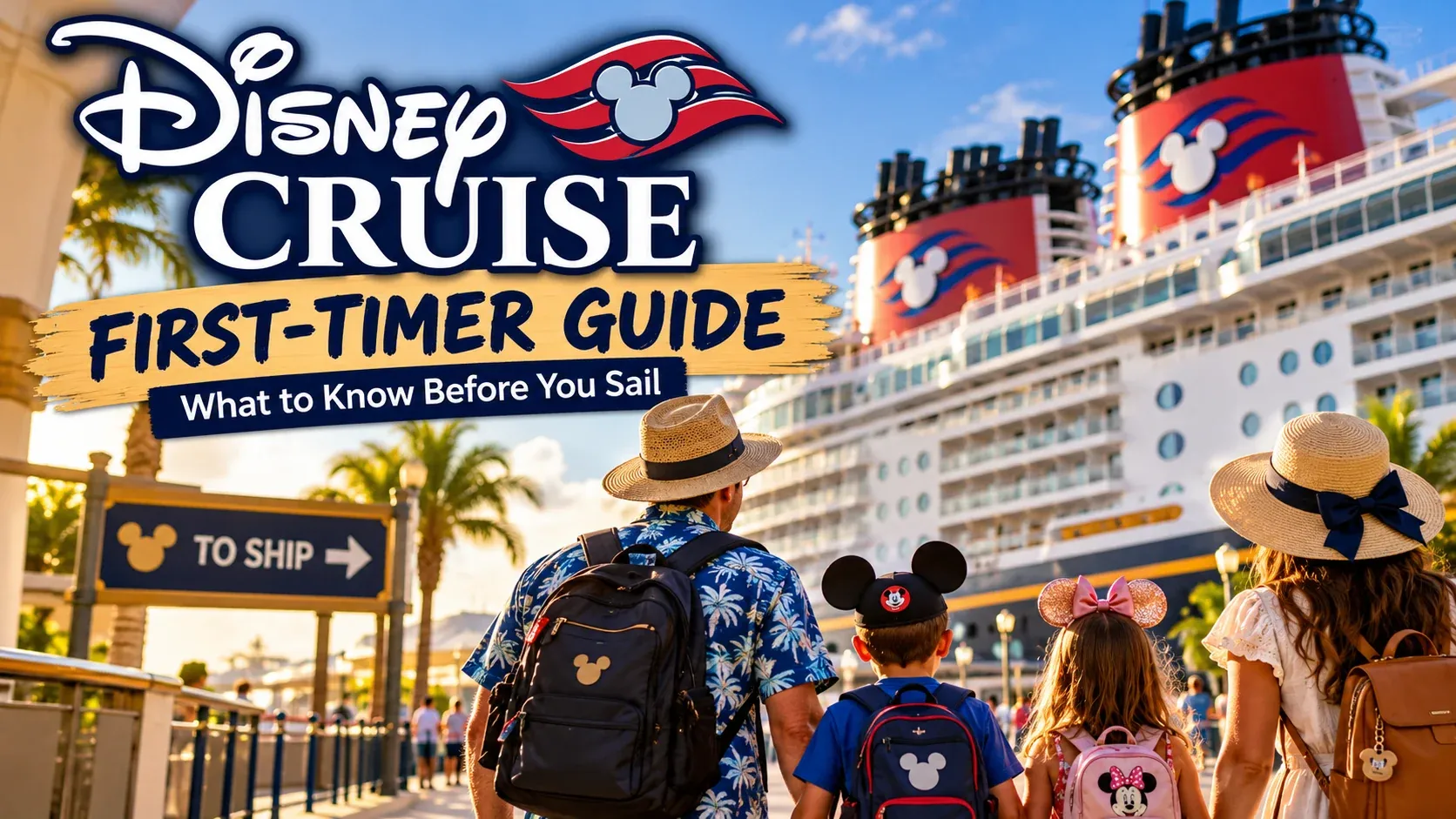
Booking your first Disney cruise can feel weirdly complicated.
Which ship?
How many nights?
Which stateroom?
Do you need a passport?
What is rotational dining?
When can you book excursions?
What exactly are you supposed to do on embarkation day?
And why does everyone suddenly have very strong opinions about verandahs?
The good news is that Disney Cruise Line is actually pretty easy once you understand the rhythm.
This guide walks you through the entire process from choosing the trip to walking onto the ship.
No twenty-seven-tab research spiral required.
Step 1: Pick the Vacation Before the Ship
This is the first mistake I would avoid.
Do not start by saying:
"I want to sail on the newest Disney ship."
Start with:
- Where do we want to go?
- How many nights do we want?
- Which departure ports work for us?
- What dates work?
- What budget feels reasonable?
Then look at which ships fit those answers.
A seven-night Caribbean sailing on an older ship may give you a much better vacation than squeezing onto a newer ship for three nights just because it is newer.
Compare the Disney Cruise Ships →
Step 2: Decide How Many Nights You Actually Want
Disney offers everything from short escapes to much longer destination-focused voyages.
For a first cruise:
3 Nights
Good for:
- testing whether you like cruising
- a quick Disney fix
- pairing with a Florida vacation
The downside?
It is over almost immediately.
You may spend half the trip figuring out where everything is.
4 Nights
This is often a much better introduction.
You get enough time to:
- explore the ship
- see the shows
- experience rotational dining
- enjoy a Disney island day
- have some actual downtime
5–7 Nights
This is where Disney cruising starts to feel like a complete vacation instead of a sampler.
More sea days give you time to use:
- pools
- adult spaces
- restaurants
- lounges
- kids clubs
- entertainment
- spa
- onboard activities
If budget allows, I generally prefer enough nights that you do not feel like you need to sprint through the ship.
Step 3: Choose the Right Ship
Disney currently operates several very different generations of ships.
Broadly:
Magic and Wonder
Smaller, more traditional and easier to navigate.
Dream and Fantasy
Larger but still very much in the classic Disney Cruise Line mold.
Wish, Treasure and Destiny
Newer-generation ships with stronger franchise-based theming and very different layouts.
Adventure
A much larger and fundamentally different Disney cruise product sailing from Singapore.
There is no universal "best ship."
There is only the best ship for your trip.
Read the Complete Disney Cruise Ships Guide →
Step 4: Choose Your Stateroom
Your basic Disney Cruise Line categories are generally:
- Inside
- Oceanview
- Verandah
- Concierge
The biggest question is usually:
Do I need a verandah?
Maybe.
A verandah can be fantastic if:
- you enjoy quiet mornings outside
- you want private ocean views
- you have kids who go to bed earlier than you
- you are sailing somewhere scenic
- you spend meaningful time in the room
But if you're going to spend twelve waking hours outside the cabin, you may be paying a lot for a balcony you barely use.
On short cruises especially, I would rather spend money intentionally than automatically upgrade.
Step 5: Understand What Your Cruise Fare Includes
A Disney cruise fare typically covers the major pieces of the onboard vacation:
- your stateroom
- rotational dining
- many quick-service food options
- most entertainment
- stage shows
- pools
- youth clubs
- many character experiences
- many onboard activities
But plenty of things can cost extra.
Examples include:
- gratuities
- alcohol
- specialty drinks
- adult dining
- spa treatments
- Port Adventures
- some premium experiences
- internet
- souvenirs
- transportation
- pre- and post-cruise hotels
Disney currently recommends gratuities of $16 per person, per night for standard accommodations, with a higher recommended amount for Concierge.
We will break this down in detail in:
How Much Does a Disney Cruise Cost? →
Step 6: Download the Disney Cruise Line Navigator App
Do this before the cruise.
The app becomes your control center.
Before sailing, you can use it for things such as:
- payments
- planning
- activity reservations
- Port Adventures
- online check-in
Once onboard, it becomes even more useful for:
- daily schedules
- activity times
- character appearances
- dining information
- messaging
- reservations
- ship information
Disney strongly recommends using the Navigator app because so much onboard information flows through it.
Step 7: Know Your Booking Window
For first-time Disney Cruise Line guests, the current advance booking window for eligible onboard activities and Port Adventures begins 75 days before sailing, after the cruise is paid in full.
Returning guests can receive earlier access based on Castaway Club level.
This matters because popular activities can fill.
Things worth watching include:
- Port Adventures
- adult dining
- spa treatments
- premium experiences
- select character experiences
My advice?
Do not book things simply because you can.
Book the things you would actually be disappointed to miss.
Step 8: Online Check-In Opens 30 Days Before Sailing
For first-time Disney Cruise Line guests, online check-in currently opens 30 days before departure.
During check-in you will provide required information and select an available:
Port Arrival Time
This is important.
Your Port Arrival Time determines when you should arrive at the terminal.
Disney specifically advises guests not to arrive before their assigned time because early arrivals may be required to wait outside.
Do not turn embarkation morning into a competition to see who can stand outside the terminal longest.
Step 9: Get Your Travel Documents Right
This is not the part to improvise.
Documentation requirements vary based on:
- itinerary
- citizenship
- departure country
- ports visited
- how you are entering or leaving a country
Disney requires guests to present appropriate citizenship documentation at check-in, and some itineraries or travelers may require passports and/or visas.
My practical advice:
Use a valid passport whenever practical.
Even when another form of documentation may technically be allowed on a particular itinerary, a passport can make unexpected international travel situations significantly easier.
Always verify your exact sailing's requirements directly with Disney and the appropriate government authorities before departure.
Step 10: Understand Rotational Dining
This is one of Disney Cruise Line's signature features.
Instead of eating in the same dining room every night, your party rotates among different restaurants.
The important part:
Your serving team rotates with you.
So your server and assistant server get to know:
- your preferences
- your kids
- what you drink
- dietary needs
- your dinner rhythm
That continuity is part of what makes Disney dining feel different.
Your dining rotation is assigned by Disney.
You just show up where the Navigator app tells you.
Step 11: Main Dining vs Second Dining
Disney usually offers two dinner seatings.
Broadly:
Main Seating
Earlier dinner.
Often preferred by:
- families with younger kids
- people who eat early at home
Second Seating
Later dinner.
Often preferred by:
- adults
- families with older children
- people who don't want to rush back from port
There is no universally better option.
Think about how your family naturally eats.
Vacation gets easier when you stop fighting your normal rhythm.
Step 12: Don't Overbook the Cruise
This may be the most important advice in this entire guide.
Your first instinct may be to reserve:
- excursions
- brunch
- dinner
- spa
- character events
- tastings
- photos
- activities
- everything Disney allows you to click
Then suddenly you are running around the ship like you're late for a meeting.
Leave room.
Some of the best cruise moments happen when you:
- stumble into a lounge
- sit on deck
- watch the ocean
- grab ice cream
- catch live music
- let the kids stay in the club
- do absolutely nothing
You paid to be on the ship.
Spend some time being on the ship.
Step 13: Don't Skip the Adult Spaces
Disney cruising is not just for children.
Adults can find:
- lounges
- specialty dining
- Quiet Cove areas
- spa experiences
- tastings
- adult nightlife
- adult-exclusive beaches at Disney island destinations
Parents should feel zero guilt about using them.
Your children being thrilled in the kids club while you have a drink somewhere quiet is not a failure of family vacation planning.
It is elite family vacation planning.
Step 14: Kids Clubs Are a Major Part of the Product
Disney puts serious effort into youth programming.
Depending on age and ship, there are dedicated spaces for:
- younger children
- tweens
- teens
Take the kids to the open house when available.
Let them understand the spaces before dropping them off.
And if they love it?
Excellent.
That is not time away from the family vacation.
That is part of the family vacation.
Step 15: Know the Disney Island Difference
Many Bahamas and Caribbean Disney sailings include one or both of Disney's island destinations.
Castaway Cay
Disney's longtime private island destination.
Known for:
- beaches
- biking
- snorkeling
- family activities
- adult-exclusive Serenity Bay
- easy ship-to-island access
Lookout Cay at Lighthouse Point
A newer Disney destination with a stronger emphasis on Bahamian culture and design.
It offers a different experience and should not simply be thought of as Castaway Cay with different landscaping.
Both deserve their own guides.
Step 16: Pack a Cruise Carry-On Properly
When you board, your checked luggage may not immediately be available.
Keep important items with you.
Examples:
- passports and travel documents
- medications
- valuables
- swimsuit
- sunscreen
- phone charger
- anything children absolutely need
- anything you need before dinner
Do not put essential travel documents into checked luggage.
Ever.
Step 17: Your First Afternoon Should Be Simple
Once onboard:
1. Eat lunch. 2. Explore the ship. 3. Confirm dining and key reservations. 4. Visit kids-club open houses if relevant. 5. Find your stateroom when available. 6. Complete required safety procedures. 7. Stop trying to "maximize" everything.
You're on vacation now.
Act accordingly.
Step 18: Use Port Days Intentionally
You do not automatically need an excursion at every port.
Some ports are better for:
- organized excursions
- beaches
- walking
- food
- history
- staying on the ship
Port Adventures can be booked once your eligible advance booking window opens, and Disney recommends booking popular excursions early because availability can fill.
But "there is an excursion available" is not the same thing as "you should book it."
This is where our Port to Pour guides will come in.
Step 19: Character Reservations Work Differently
Many character appearances do not require reservations.
Some special experiences do.
For most ships, Disney currently allows eligible guests to book the complimentary Royal Gathering beginning 30 days before sailing, once the cruise is paid in full. Disney Adventure may handle select character experiences differently.
This is another reason to check your exact ship rather than assuming every Disney cruise works identically.
Step 20: Don't Try to Do Everything
You won't.
That is fine.
You will miss:
- activities
- character appearances
- food
- shows
- trivia
- lounges
- pool time
- probably something you didn't even know existed
The solution is not to sprint harder.
The solution is another cruise.
Convenient how that works.
What I Would Prioritize on a First Disney Cruise
If I were helping a first-timer simplify the experience, I would prioritize:
1. Rotational dining
Do the core Disney dining experience.
2. At least one major stage show
Disney puts real production value into its theater entertainment.
3. Explore the ship
Don't just move between scheduled activities.
4. Use the kids clubs if applicable
They are part of what you're paying for.
5. Find an adult space
Even if it's just one cocktail.
6. Enjoy the Disney island destination if included
Especially on a first Bahamas sailing.
7. Leave unscheduled time
This is non-negotiable.
What You Probably Don't Need on Your First Cruise
You probably do not need:
- every paid add-on
- the most expensive stateroom
- an excursion at every port
- a full wardrobe of matching shirts
- a complicated door-decoration operation
- a spreadsheet with fifteen-minute time blocks
- to know every Disney Cruise Line secret before boarding
It is okay to discover things while you're there.
That is still allowed.
First Disney Cruise Checklist
Before you leave home, make sure you have:
- required travel documents
- Navigator app
- online check-in completed
- Port Arrival Time
- transportation arranged
- hotel arranged if arriving early
- essential reservations completed
- gratuity plan understood
- carry-on packed correctly
- luggage prepared
- medications
- payment method
- realistic expectations
Then stop planning.
Go on vacation.
Is Disney Cruise Line Good for First-Time Cruisers?
Yes, especially if you already enjoy Disney and want a cruise product that makes family logistics relatively easy.
Disney is particularly strong at:
- family programming
- entertainment
- kids clubs
- service
- dining continuity
- character experiences
- private-island days
The main drawback is usually price.
That is why the next question shouldn't be:
"Is Disney good?"
It should be:
"Is Disney worth the premium for this particular trip?"
We'll tackle that next.
Read: How Much Does a Disney Cruise Cost? →
One Last Piece of Advice
You do not need to become an expert before your first Disney cruise.
Choose a good trip.
Get the important logistics right.
Leave yourself room to discover the rest.
And pack the Hawaiian shirt.
Keep exploring: Best Disney Cruise Ship for First-Timers, Disney Cruise Check-In Guide and Disney Cruise Packing Guide.