
Field Notes · November 16, 2026 · Tiki & Hawaiiana
The History of the Aloha Shirt: From Island Origins to Global Icon
Discover the history of the aloha shirt, from Hawaiʻi's multicultural origins and early pioneers to Alfred Shaheen, vintage designs, and modern aloha wear.
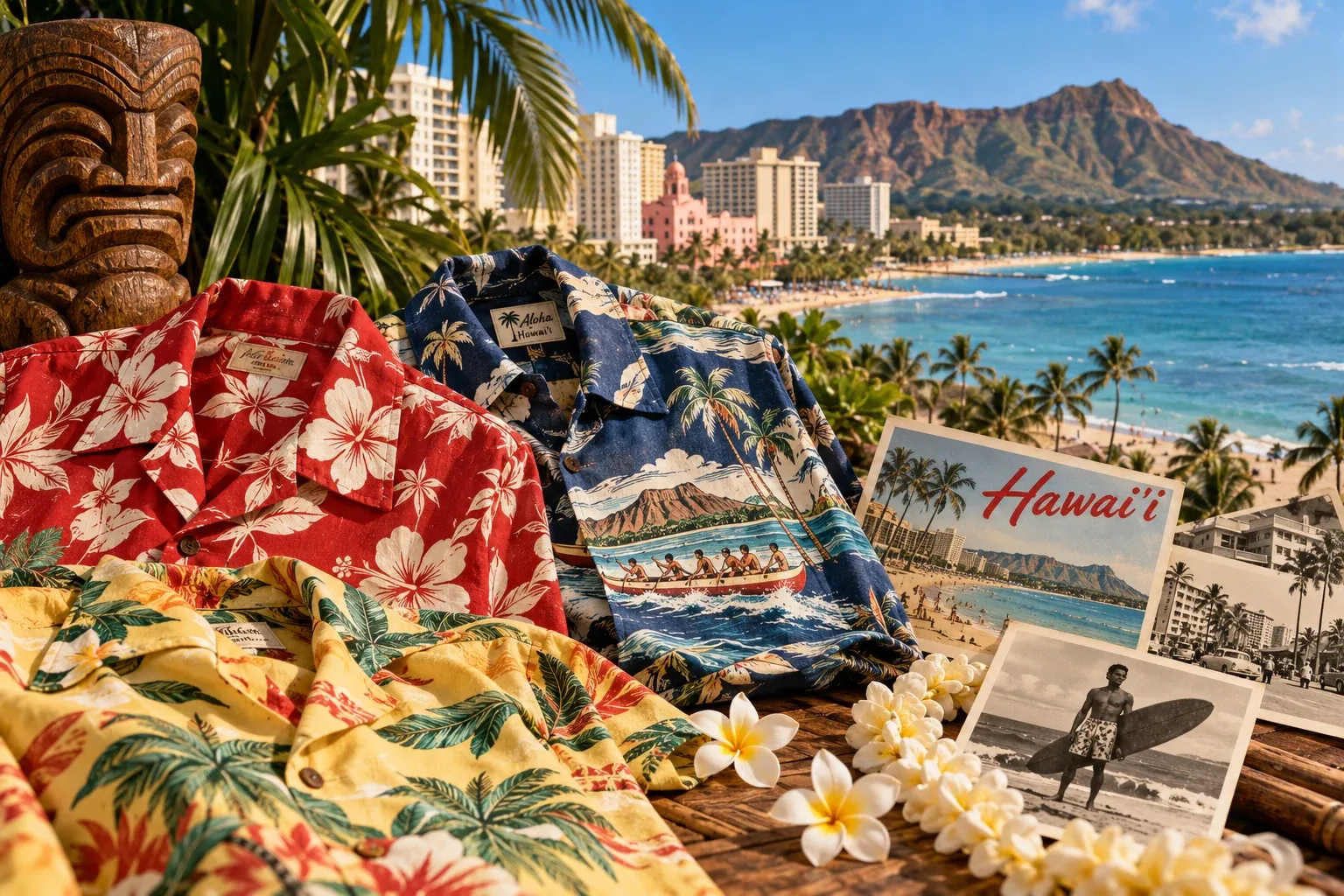
There are few articles of clothing that can change the mood of an entire room quite like an aloha shirt.
Walk into a party wearing a navy blazer and nobody thinks twice. Walk into that same party wearing a vintage Hawaiian shirt covered in tropical flowers, and suddenly people want to know where you're going on vacation.
That's the magic of a great aloha shirt.
But behind those colorful prints is a story far more interesting than palm trees, beach vacations, and poolside cocktails.
The aloha shirt wasn't simply invented as a souvenir for American tourists. It developed in Hawaiʻi through a remarkable convergence of immigrant craftsmanship, imported textiles, local fashion, entrepreneurial experimentation, and changing ideas about how people should dress.
Its history includes competing claims of invention, talented designers who rarely receive enough credit, a textile industry that helped put Hawaiʻi on the fashion map, and a cultural identity that goes far beyond the shirt's popularity on the mainland.
To understand the aloha shirt, we have to look beyond the print.
We have to look at the people who made it.
Before the Aloha Shirt: A Multicultural Fashion Story

The story begins long before someone decided to sew a palm tree onto a shirt.
During the late nineteenth and early twentieth centuries, Hawaiʻi experienced enormous social, economic, and cultural change.
Immigrants from China, Japan, the Philippines, Portugal, and elsewhere brought their own traditions, skills, and clothing preferences to the islands. These communities interacted with Native Hawaiians and other residents in an increasingly diverse society.
The result was a distinctive local culture that influenced everything from food and music to language and fashion.
Clothing was no exception.
Japanese fabrics, including printed kimono silks and other lightweight textiles, became available through local merchants. Chinese and Japanese tailors operated shops in Honolulu, where they produced garments for residents and visitors.
Meanwhile, Western-style shirts had become familiar everyday clothing.
Put those ingredients together and something interesting becomes possible.
A shirt with a familiar Western silhouette could be made from fabric featuring bold Japanese-inspired designs. It could be lightweight enough for Hawaiʻi's climate, colorful enough to stand out, and comfortable enough for an increasingly casual lifestyle.
There wasn't necessarily a single moment when the aloha shirt suddenly appeared.
Instead, several influences were gradually coming together.
Fashion historian Linda B. Arthur, whose research examined more than 1,000 shirts and textiles, concluded that the aloha shirt's development reflected contributions from multiple ethnic communities in Hawaiʻi.
That matters because the familiar story of one entrepreneur inventing the Hawaiian shirt overlooks the multicultural society that made the garment possible.
Who Invented the Aloha Shirt?

Here's where the history gets particularly interesting.
Ask who invented the aloha shirt, and you'll encounter several names.
Two of the most frequently cited are Koichiro Miyamoto, associated with the Musa-Shiya shirtmaking business, and Ellery Chun of King-Smith Clothiers.
Both deserve a place in the history.
Neither should automatically receive sole credit for inventing the garment.
Koichiro Miyamoto and Musa-Shiya
On June 28, 1935, a Honolulu newspaper carried an advertisement for Musa-Shiya Shoten, Ltd., a shirtmaking business associated with Koichiro Miyamoto.
The advertisement promoted shirts using the term "aloha."
This is an important historical detail because it is among the earliest documented commercial uses of the phrase "aloha shirt."
The business offered colorful garments that could be purchased ready-made or tailored to order.
Imagine that for a moment.
It's the middle of the Great Depression. A Honolulu shirtmaker is advertising bright, comfortable clothing to people who want something distinctly associated with Hawaiʻi.
The advertising wasn't simply describing a garment.
It was helping establish an identity for an emerging product.
Ellery Chun and King-Smith Clothiers
Ellery Chun was working in his family's Honolulu dry-goods business, King-Smith Clothiers, during the same general period.
Chun recognized a commercial opportunity in lightweight, colorful shirts that could be sold directly to customers without requiring a special tailoring appointment.
He helped popularize aloha shirts through ready-made merchandise, store displays, and persistent advertising.
Chun also became associated with trademarking the terminology used to market aloha apparel during the 1930s.
His business contributions helped move the garment toward a recognizable commercial category.
But selling a product successfully, promoting its name, and inventing the first example are three different achievements.
The historical record supports Chun's importance as a commercial pioneer without proving that he personally invented the original aloha shirt.
The Forgotten Stories Before the Famous Names
Other accounts place the beginnings of the aloha shirt even earlier.
Writer and clothing historian Dale Hope documents stories of young men in Hawaiʻi wearing shirts made from Japanese fabrics during the 1920s.
One account concerns University of Hawaiʻi student Gordon Young, whose mother reportedly arranged for shirts to be made using Japanese cotton fabrics.
There are also early shirtmaking businesses and manufacturers whose contributions complicate the idea of a single inventor.
The evidence doesn't establish one universally accepted creator.
And perhaps that's the appropriate conclusion.
The aloha shirt emerged from a community of people who were already experimenting with fabrics, tailoring, personal style, and local identity.
Its story is richer when those contributions are acknowledged instead of reduced to one convenient name.
The 1930s: The Aloha Shirt Finds Its Identity
By the 1930s, Hawaiʻi had become an increasingly attractive destination for travelers seeking warm weather and an imagined escape from everyday life.
Tourism created demand for souvenirs.
And clothing offered something particularly appealing.
A visitor could purchase an aloha shirt, wear it during a vacation, and carry a little piece of that experience home.
Unlike a postcard or decorative object, a shirt became part of the wearer's everyday life.
Early examples didn't always resemble the familiar hibiscus-covered Hawaiian shirts of later decades.
Some featured Japanese-inspired patterns, geometric designs, and other motifs reflecting the textiles available in Hawaiʻi.
As the market expanded, designers and manufacturers developed prints that more explicitly referenced the islands.
Flowers, tropical foliage, ocean imagery, and scenes associated with Hawaiʻi gradually became part of the garment's visual language.
This was also when an important distinction began to develop.
The aloha shirt could reflect the fashion preferences and multicultural identity of Hawaiʻi's residents.
At the same time, it could serve as a souvenir designed to satisfy outsiders' expectations of tropical paradise.
Those two purposes would continue shaping its history.
World War II Changes Everything
The attack on Pearl Harbor on December 7, 1941, transformed life in Hawaiʻi.
Tourism was disrupted, wartime restrictions affected commerce, and local manufacturers faced changing access to materials.
The garment industry also participated in wartime production.
Yet the war and its aftermath helped expose the aloha shirt to a much wider audience.
American military personnel stationed in the Pacific encountered Hawaiian clothing and brought shirts home as souvenirs.
After the war, travel expanded and demand for casual clothing increased.
The aloha shirt was perfectly positioned for that changing world.
It was colorful, comfortable, distinctive, and associated with a destination that Americans increasingly imagined as a place of recreation.
The postwar years would turn it from a regional garment into an international fashion symbol.
The Golden Age of the Hawaiian Shirt

For many vintage collectors, the late 1940s through the 1950s represent the golden age of aloha shirt design.
And it's easy to understand why.
This period produced extraordinary examples of textile printing, color combinations, and garment construction.
Rayon shirts with dramatic prints became particularly associated with the era.
Some featured large tropical flowers. Others included geometric compositions, sailing imagery, island landscapes, or stylized scenes inspired by the broader Pacific.
The best examples weren't simply pieces of fabric covered in repeating pictures.
They were carefully designed garments.
Pattern placement mattered.
Color mattered.
Even the way a printed design flowed across a pocket or button opening could distinguish a beautifully made shirt from an ordinary one.
Manufacturers developed recognizable identities through their prints, labels, construction details, and marketing.
The shirts increasingly became associated with entertainers, vacationers, surfers, and the growing culture of American leisure.
From Hawaiʻi to Hollywood
Popular entertainment gave the aloha shirt another enormous advantage.
Actors, musicians, and other public figures wore Hawaiian clothing in films, photographs, performances, and promotional appearances.
The garment became familiar even to people who had never visited the islands.
Elvis Presley helped reinforce that association through the 1961 film Blue Hawaii and its accompanying imagery.
The film's red aloha shirt became one of the more recognizable examples of the garment's place in American popular culture.
But the shirt's popularity also created a contradiction.
The farther it traveled from Hawaiʻi, the easier it became for outsiders to associate it exclusively with beaches, exotic vacations, and fantasy.
The garment's actual origins were considerably more complex.
Alfred Shaheen and the Art of the Aloha Shirt

If the early history of the aloha shirt is about cultural influences and competing origin stories, its mid-century history is also about manufacturing innovation.
And one of the most significant names is Alfred Shaheen.
Shaheen came from a family with deep experience in textile manufacturing.
His family's Lebanese immigrant heritage and garment-industry background contributed to the expertise that eventually helped transform aloha wear production in Hawaiʻi.
In 1948, Shaheen established a business that would grow into one of the islands' most influential fashion operations.
Rather than relying entirely on imported printed fabrics, he developed the capability to create textiles in Hawaiʻi.
That meant designing prints, preparing colors, printing fabrics, and manufacturing finished garments as parts of a coordinated operation.
A Factory That Became a Creative Community
Shaheen's business was more than a shirtmaking operation.
It brought together designers, chemists, printers, garment workers, and other skilled specialists.
His mother, Mary Shaheen, contributed artistic knowledge and helped train workers.
Chemist Edmund Lutz played an important role in developing specialty dyes.
Textile designer Robert Sato contributed to the company's visual language.
Other creative professionals and production workers helped transform designs into finished clothing.
Their work deserves recognition alongside the name on the label.
By the late 1950s, Shaheen's company had developed into a substantial manufacturing enterprise with hundreds of employees and international distribution.
Its success demonstrated that clothing designed and produced in Hawaiʻi could compete in a much larger fashion marketplace.
Why Shaheen Shirts Still Matter
Shaheen's garments are remembered for sophisticated prints, careful craftsmanship, and ambitious textile design.
They also reveal something important about the aloha shirt.
Its development wasn't limited to putting tropical images onto clothing.
The industry's most accomplished manufacturers treated fabric as an artistic medium.
Color, pattern, texture, cutting, and construction all worked together.
A shirt could be practical clothing, a souvenir, a fashion statement, and a work of textile design at the same time.
For collectors, that combination remains part of the attraction.
The Aloha Shirt Becomes Everyday Clothing in Hawaiʻi

By the 1960s, the aloha shirt was already known around the world.
But another important transformation was underway at home.
In Hawaiʻi, the garment was becoming increasingly acceptable in professional settings.
Traditional business clothing often meant jackets, ties, and other relatively formal attire.
That approach could feel out of place in a warm climate.
Local clothing manufacturers and business advocates promoted aloha wear as an appropriate alternative.
The concept gained momentum during the 1960s and became closely associated with Aloha Friday, formally established as a recurring workplace custom in 1966.
By approximately 1970, aloha shirts had become widely accepted as professional attire in Hawaiʻi.
From Aloha Friday to Casual Friday
Today, the idea of dressing more casually at the end of the workweek seems ordinary.
But Hawaiʻi's Aloha Friday movement helped demonstrate how workplaces could embrace less formal clothing while maintaining professional standards.
The custom is often identified as an influence on the later spread of Casual Friday on the American mainland.
The relationship between the two traditions shouldn't be reduced to a single straight line, but the Hawaiian precedent is historically important.
More importantly, aloha wear's acceptance in Hawaiʻi reflects a garment becoming part of everyday local identity rather than remaining merely a vacation souvenir.
The Difference Between Aloha Wear and the Tourist Hawaiian Shirt
There's an important cultural distinction worth making.
On the American mainland, a Hawaiian shirt often signals relaxation.
It might be something you wear to a backyard barbecue, a tropical-themed party, a tiki bar, or a cruise.
In Hawaiʻi, aloha shirts can serve those purposes too.
But they also have a much broader role.
Depending on the garment and occasion, aloha wear can be appropriate for business, celebrations, social gatherings, and everyday life.
Many locally favored designs are comparatively restrained.
Reverse-print fabrics, muted colors, and refined patterns can create a look quite different from an oversized souvenir shirt covered in neon palm trees.
Neither type is automatically superior.
They simply serve different markets and communicate different things.
Hawaiʻi Is Not the Same as American Polynesian Pop
This distinction is especially important when discussing aloha shirts on Tiki Tim Adventures.
American tiki culture developed its own fantasy of tropical escape, borrowing and reinterpreting imagery associated with Hawaiʻi and other Pacific Islands.
Tiki bars, tropical cocktails, exotica music, and elaborate themed environments became part of that phenomenon.
The aloha shirt found a natural home within the American tiki aesthetic.
But the shirt's actual development in Hawaiʻi was not simply a product of mainland tiki culture.
Its roots lie in Hawaiʻi's multicultural communities, garment makers, textile designers, and local clothing practices.
American Polynesian Pop adopted the aloha shirt as part of its visual identity.
It didn't create the garment or define everything it represents.
Understanding the difference makes both histories more interesting.
For a broader introduction to that distinction, explore our guide to What Is Tiki Culture? A Beginner's Guide to Polynesian Pop.
Why Vintage Aloha Shirts Became Collectible
Eventually, the same qualities that made aloha shirts fashionable also made vintage examples desirable to collectors.
The appeal isn't difficult to understand.
A well-preserved shirt from the 1940s or 1950s can capture a particular moment in textile design, fashion, and cultural history.
Collectors may appreciate its fabric, print, maker, construction, rarity, or connection to a documented era.
Some seek examples from notable manufacturers.
Others concentrate on particular motifs, periods, materials, or garment styles.
For certain enthusiasts, the hunt is primarily about craftsmanship.
For others, it's nostalgia.
And sometimes it's simply the pleasure of discovering an extraordinary piece of vintage clothing that still looks fantastic decades after it was made.
What Makes an Old Aloha Shirt Interesting?
An old shirt isn't necessarily valuable simply because it's old.
Its significance depends on several considerations.
The manufacturer and label can help identify where and when a garment was produced.
Fabric and construction techniques may offer additional dating clues.
The design itself may be historically interesting, particularly when it can be attributed to a known textile artist or manufacturer.
Condition, documented provenance, and originality also matter.
However, none of these details alone guarantees authenticity, rarity, or market value.
Collecting responsibly requires research.
That's why an understanding of aloha shirt history should come before treating vintage garments as investments.
Our forthcoming guide to collecting vintage Hawaiian shirts will explore labels, materials, condition, and authentication in greater detail.
The Aloha Shirt and Its Cultural Legacy
The aloha shirt has undergone repeated transformations.
It began as a garment shaped by the interactions of Hawaiʻi's multicultural communities.
It became a commercial product, a tourist souvenir, a symbol of postwar leisure, a fashion-design success story, and an accepted part of local professional clothing.
Its designs have evolved alongside changing tastes.
Vintage collectors have revived interest in historic prints.
Contemporary manufacturers continue interpreting the garment for new generations.
And across the world, people still put on aloha shirts for the simple pleasure of wearing something that feels more relaxed and expressive than conventional clothing.
Yet the most meaningful part of its history isn't the idea that one shirt can make someone feel like they're on vacation.
It's the fact that a seemingly simple garment carries a record of cultural exchange, individual creativity, economic change, and evolving identity.
Aloha shirts can reflect the history of Hawaiʻi's immigrant communities.
They can illustrate the skills of textile artists and garment workers.
They can reveal the commercial imagery created for visitors.
And they can show how clothing becomes part of a community's sense of itself.
Not every print should be treated as an authentic representation of Native Hawaiian culture. Some designs reflect the influence of living cultural traditions, while others are commercial interpretations created for tourism.
Recognizing those differences is part of appreciating the shirt's history.
More Than a Shirt
The next time you see a vintage aloha shirt hanging in a shop, take a closer look.
Look at the print.
Look at the fabric.
Look at the label, the stitching, and the way the pattern comes together.
Then consider the people behind it.
The tailors who experimented with imported fabrics.
The entrepreneurs who saw an opportunity.
The designers who developed unforgettable prints.
The chemists and factory workers who made those designs possible.
And the generations of people in Hawaiʻi who helped turn the aloha shirt into an enduring part of local life.
It's remarkable how much history can fit into one shirt.
Maybe that's part of why we still love them.
Some clothing follows fashion.
The best aloha shirts carry a story.
Adventure looks better in a Hawaiian shirt.
Explore More of The Aloha Archive
Curious about the collectibles, craftsmanship, and cultural history behind Hawaiiana?
Visit The Aloha Archive and Hawaiiana collection to explore more of the objects, traditions, and stories that continue to fascinate collectors and tropical-culture enthusiasts.
And if you're new to the world of tiki, start with our introduction to American Polynesian Pop to discover where those colorful worlds overlap and where their histories are distinctly different.